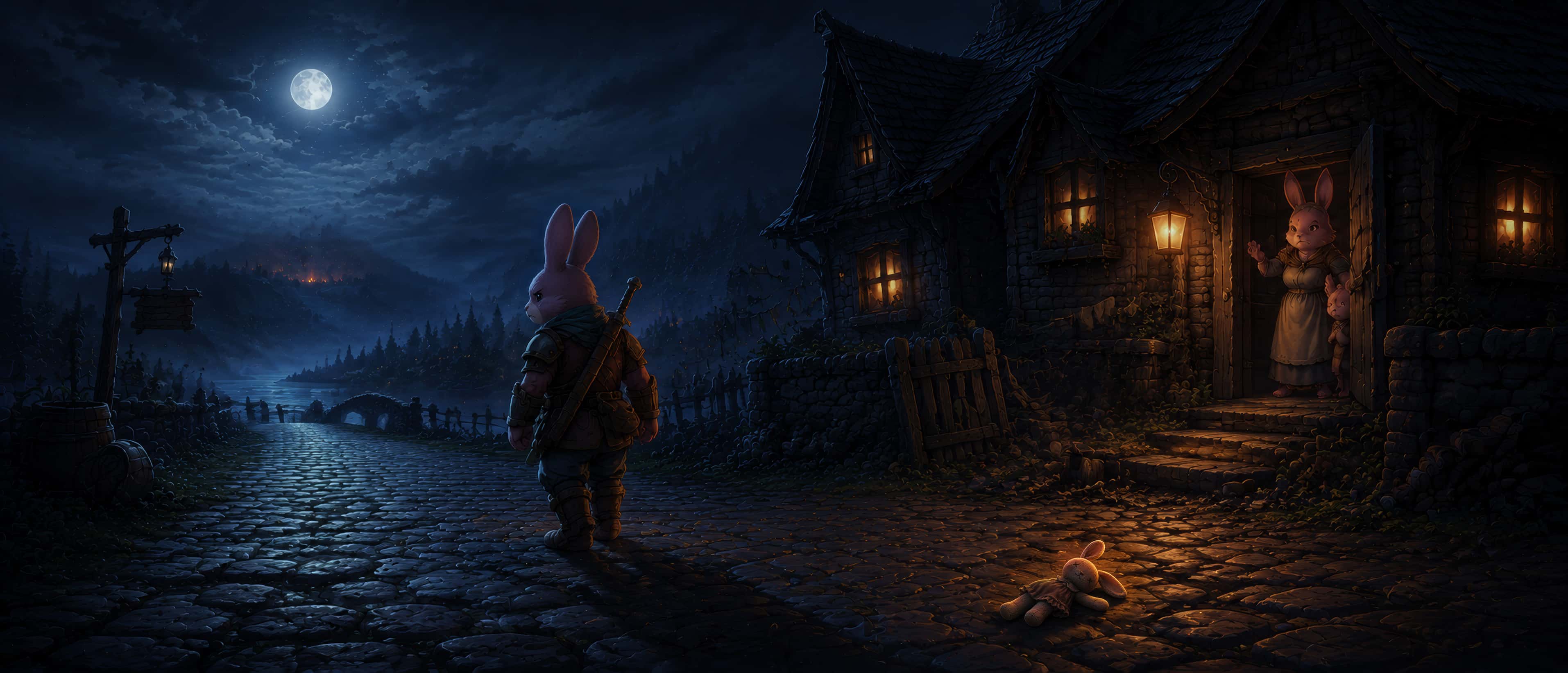
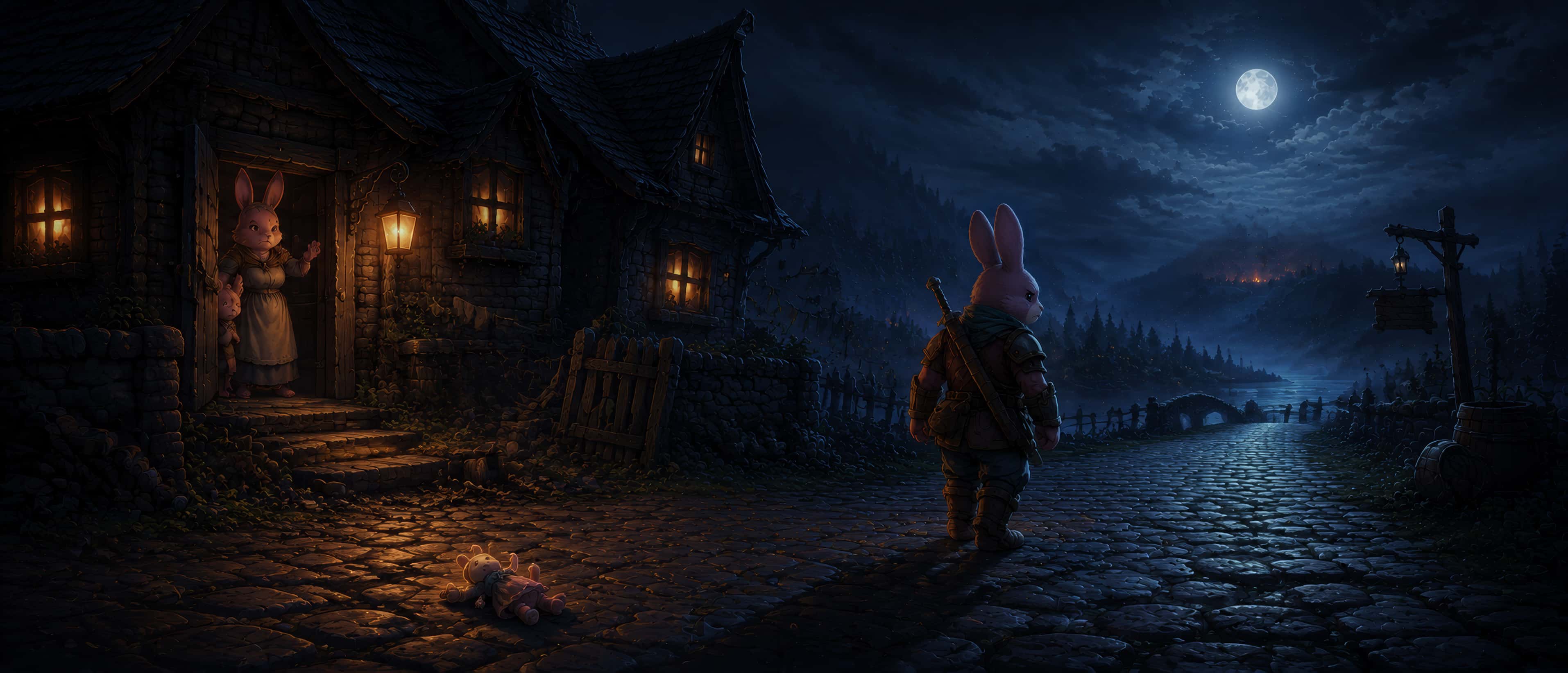
An adult rabbit in leather armour, sword across his back, walking away from a lit house over wet cobblestones under a full moon. His daughter's rag doll lies on the ground behind him.

Creative Drops Games · In development · 2027

Cannibal Bunnies

He leftto find her.

Eleven worlds. Ten bosses. A 2.5D platformer cut like a fairy tale — and fairy tales, before we softened them, had teeth.

Every fairy tale had teeth once. 

We spent a century filing them down. 

This one kept them.

World I — Moonwatch Hollow

Before everything went wrong.

The first world contains no enemies. You learn to move, to talk to people, to pick things up. It is the only time in the game you are safe — and that is exactly why it exists.

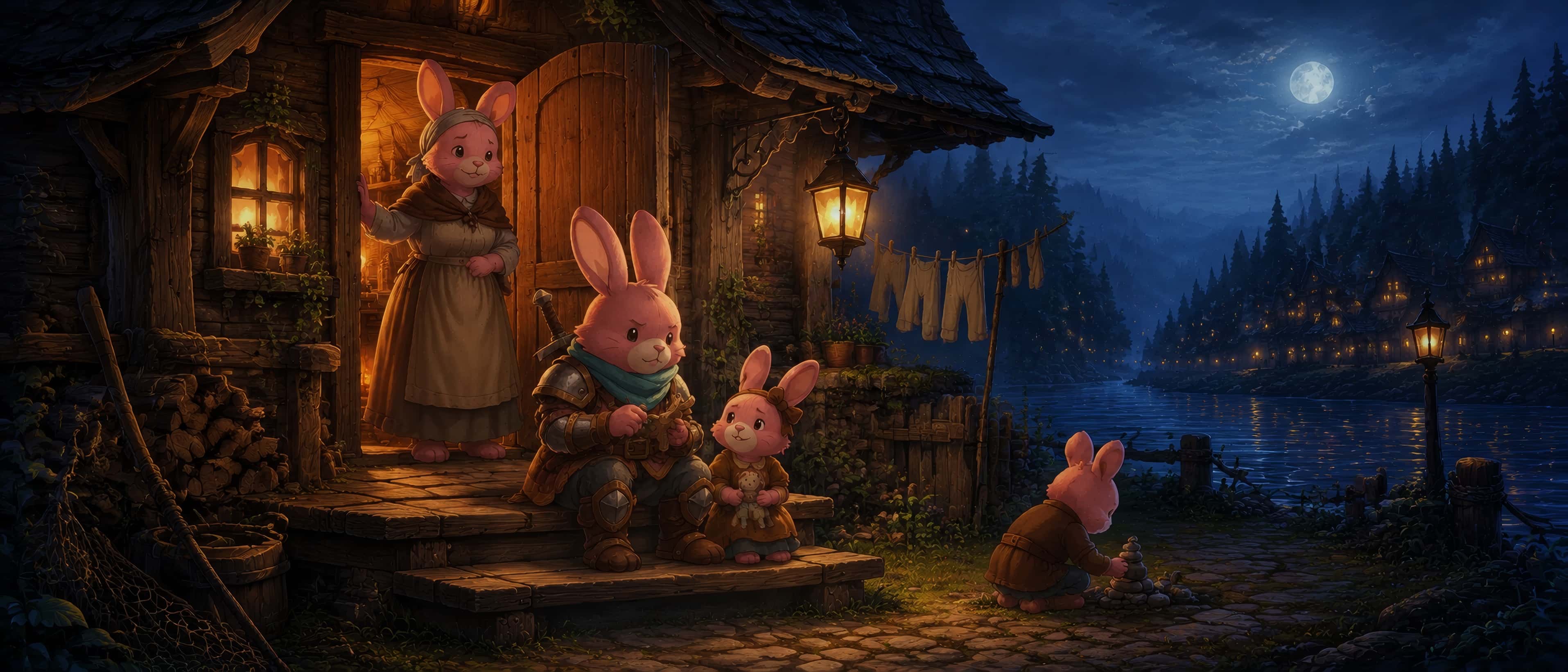
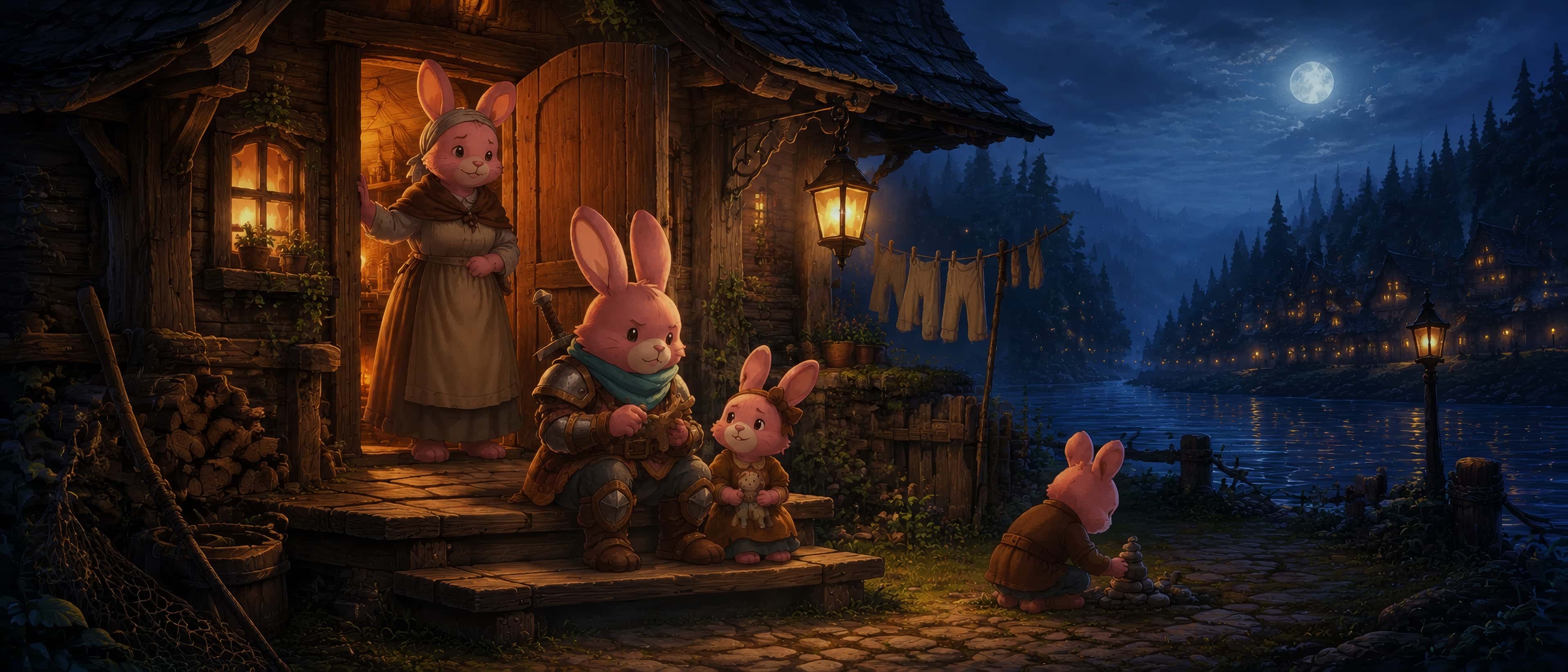
A rabbit family on the porch of a lantern-lit wooden house beside a river at night. The armoured father sits with his daughter, who is holding a rag doll.
01EveningA house by the water. Washing on the line. Nothing that announces anything.
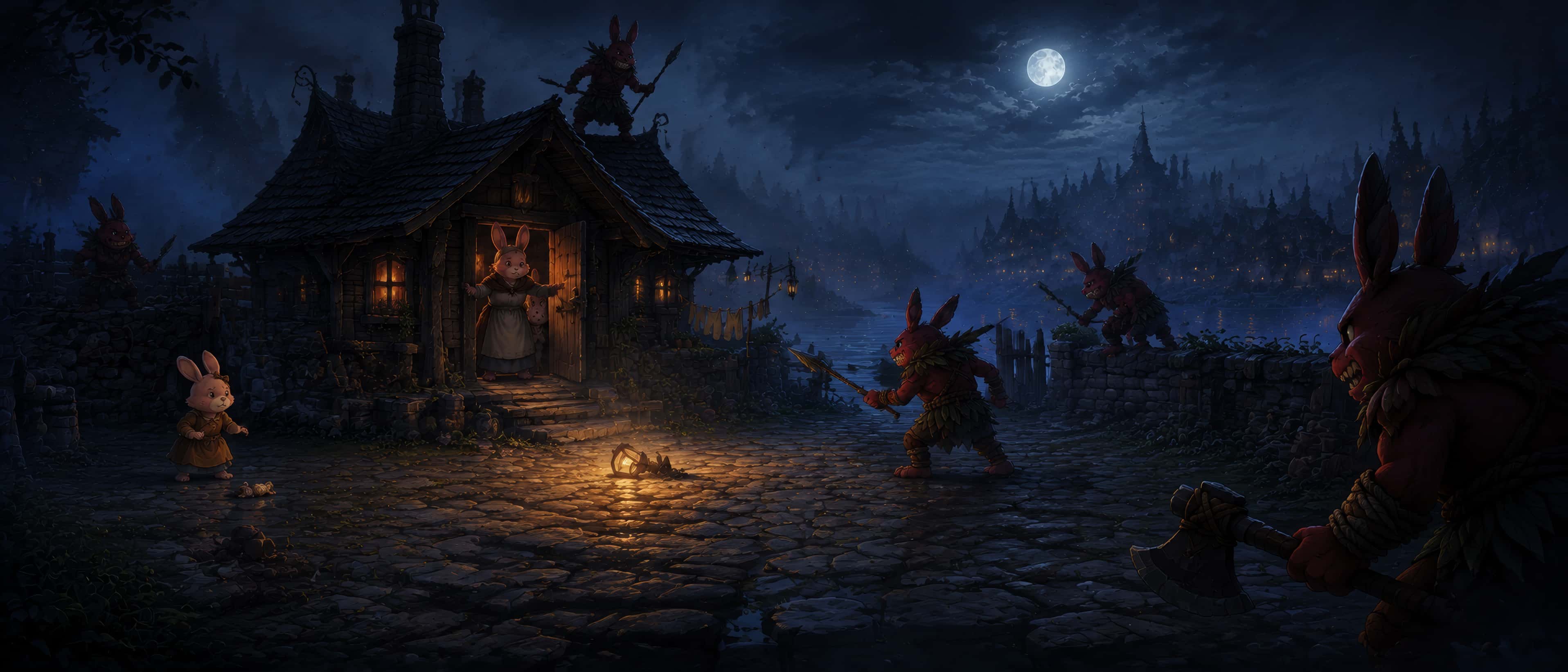
Second scene of the Cannibal Bunnies prologue.
02NightWe never show what happens. We show what is left of it by morning.
The father walks away from the house over cobblestones, sword across his back, under a full moon. His daughter's rag doll lies on the ground behind him.
03LeavingHe tells no one. He takes the sword off the wall and walks down the road.

The doll stays on the cobblestones. Remember it.

2010

This name has followed me for sixteen years.

In 2010, the iPad was not sold in Canada yet. I drove down to the United States to get some, came back with the boxes in the car, and built a game on it.

It was called Cannibal Bunnies. Apple featured it, and the press followed — Macworld, Gamezebo and 148Apps all reviewed it.

A sequel came after: Cannibal Bunnies 2 — The Lost Village, a touch platformer with forty-five levels across three worlds. It's still on the App Store.

Since then, the studio has spent fifteen years building worlds people physically walk through: immersive environments, elevators that become tunnels, installations fabricated in our own shop. We know how to make a universe stand up.

The idea never let go. So we are taking it back. Much bigger this time.

Benoit Tremblay — President, Creative Drops

The game

Four things that never live together.

A platformer played to the millisecond, an inventory played by thinking, zones that reopen when you come back stronger, and bosses you learn by heart. Each of those four ideas has its classic. None of them lives with the other three.

01

Movement first

Run, jump, dodge, air attack: everything reads frame by frame. A level played well looks like choreography. A level played badly never cheats — you missed the timing, and you know it.
02

An inventory that thinks

What you pick up isn't just a damage number. Objects combine, get given away, get traded, open doors no sword opens. Some passages aren't cleared by reflex — they're cleared by understanding.

03

Worlds that reopen

Every world keeps a door shut on your first pass. An ability earned in world VII reopens a passage in world III. The map doesn't unroll: it folds back on itself.

04

Ten bosses, ten lessons

No boss falls on the first attempt, and none of them is unfair. Each has phases, a grammar, a moment where it tips its hand. You lose, you read, you go again — and when you win, you know exactly why.

Unreal Engine

We cut the colour to see if it reads.

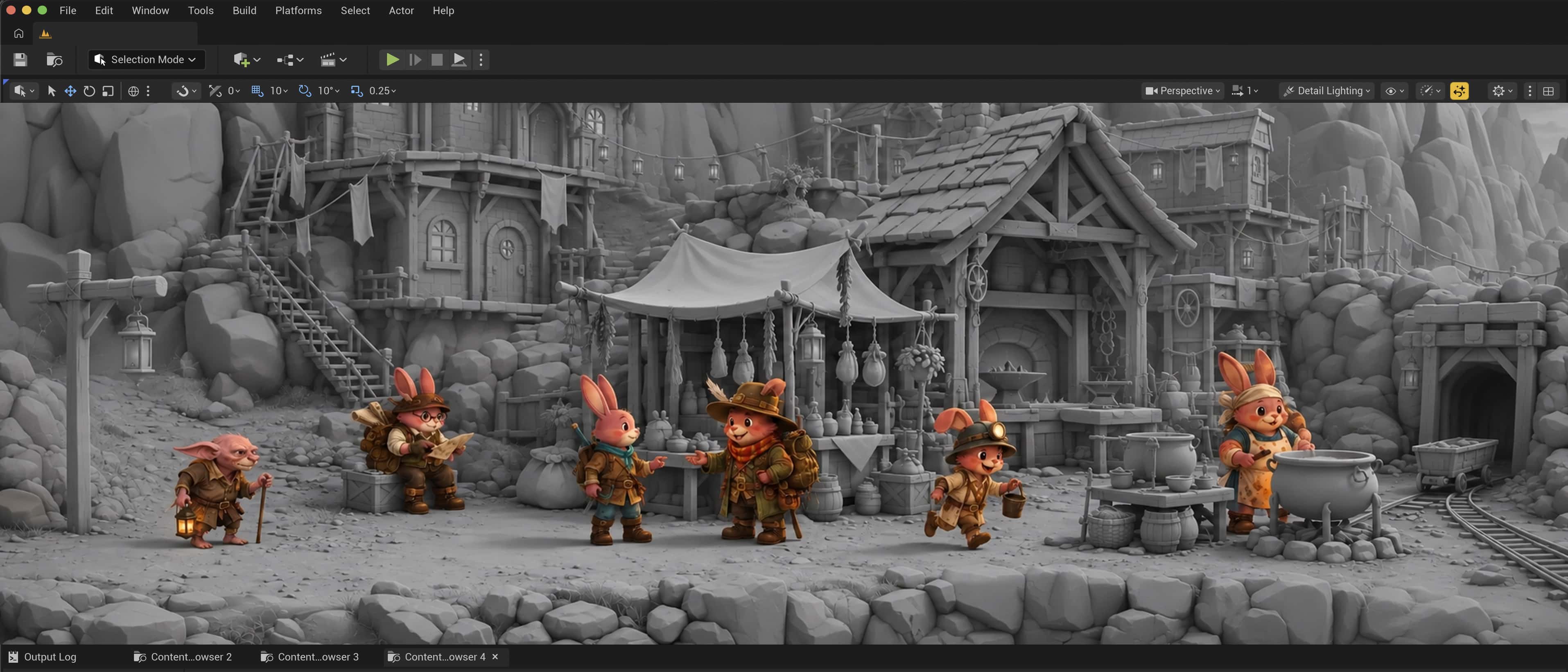
Six editor captures, taken as is, with the environment displayed without its colour. This isn't an unfinished set: it's a display mode we keep open all day. Stripped of colour, the environment can't cheat — and all that's left on screen is what the player has to see in a tenth of a second.
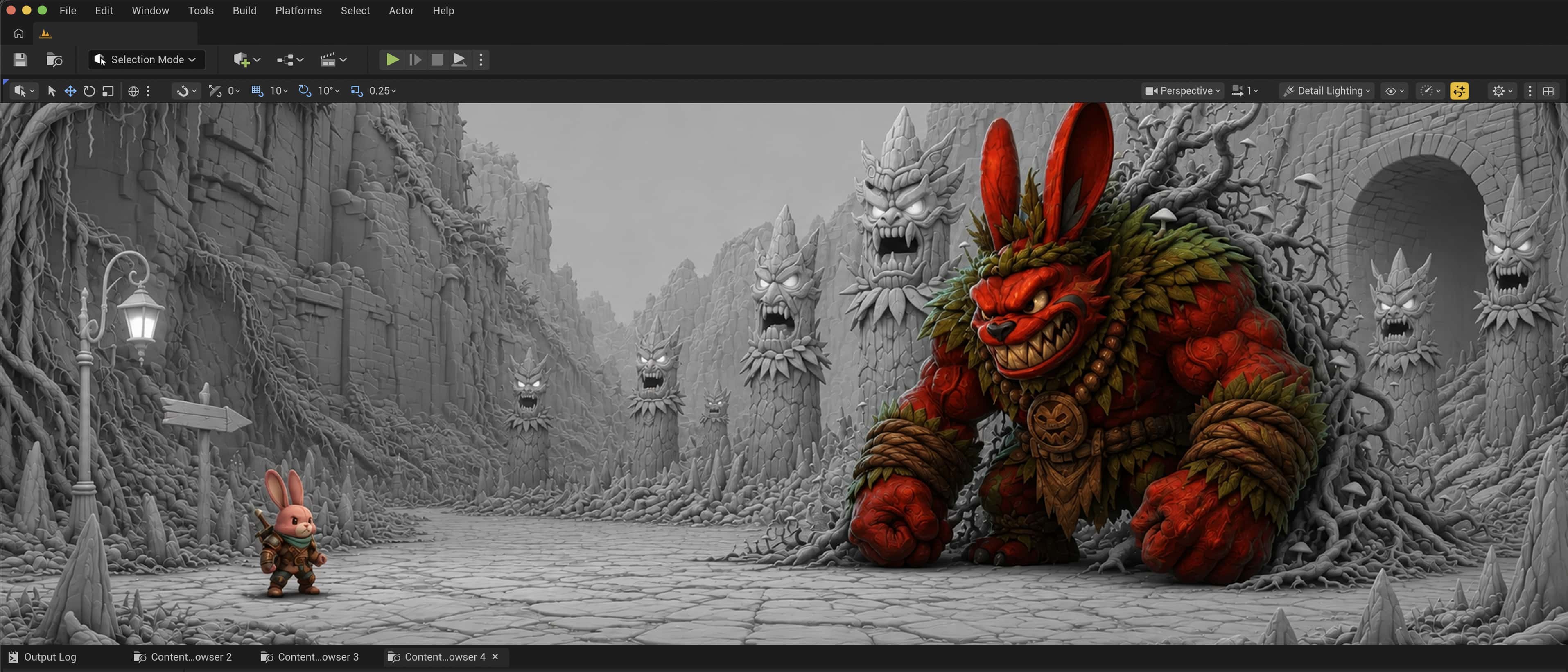
Unreal editor: the father, tiny on the left, facing the red world II boss down a corridor of carved totems. Environment shown without colour, characters in colour.
01World II — scaleThe first boss. Without the environment's colour, all that's left is two masses and the distance between them: exactly what the player perceives walking into the arena, before looking at anything.
Unreal editor: village square with an awning, a forge, a mine cart and six rabbit characters at their posts. Environment shown without colour.
02The villageSix characters, six silhouettes you have to tell apart at a glance. The environment is muted on purpose: if they stand out here, they'll stand out once the colour is back.
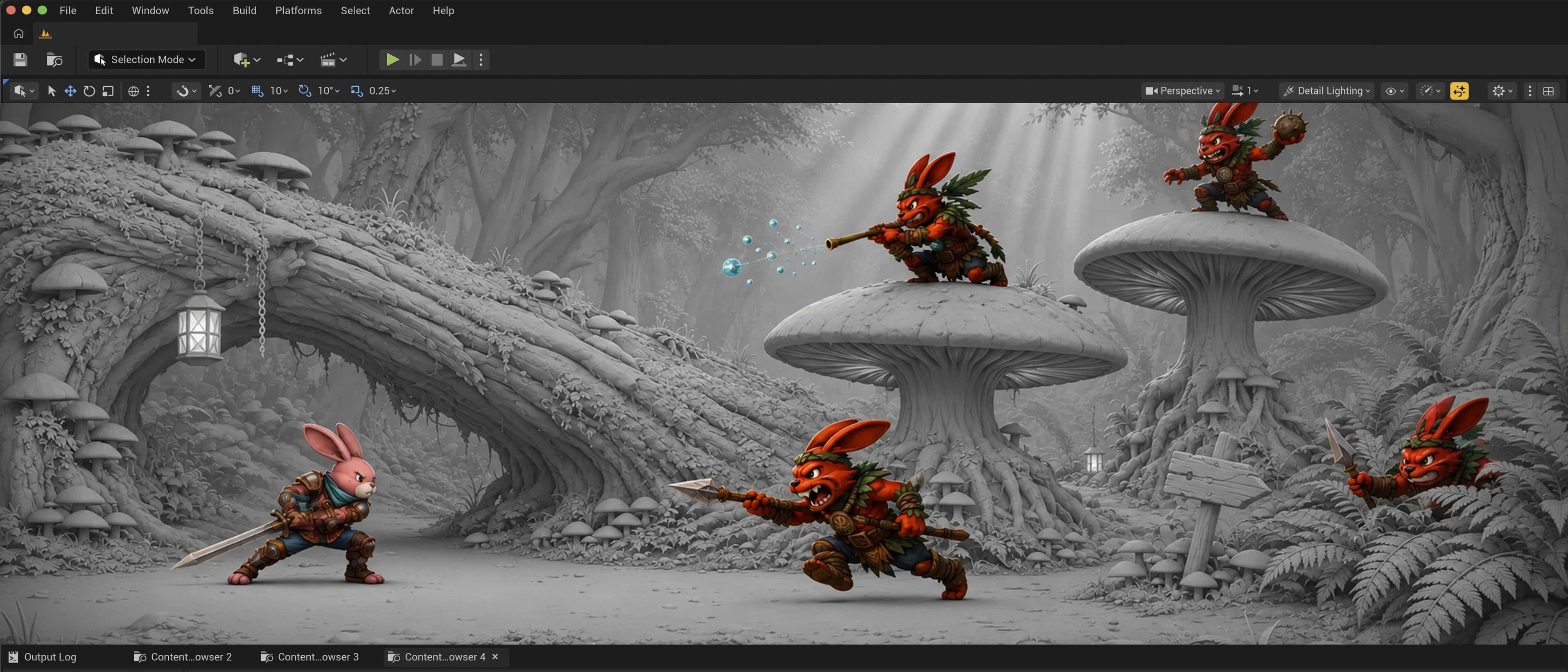
Unreal editor: the father on the left facing four red enemies staged across three levels in a giant mushroom forest.
03World II — the threatFour enemies, four roles: a spear on the ground, a blower up high, a thrower further back, an ambusher in the ferns. Depth doesn't come from the set, it comes from where each one stands.
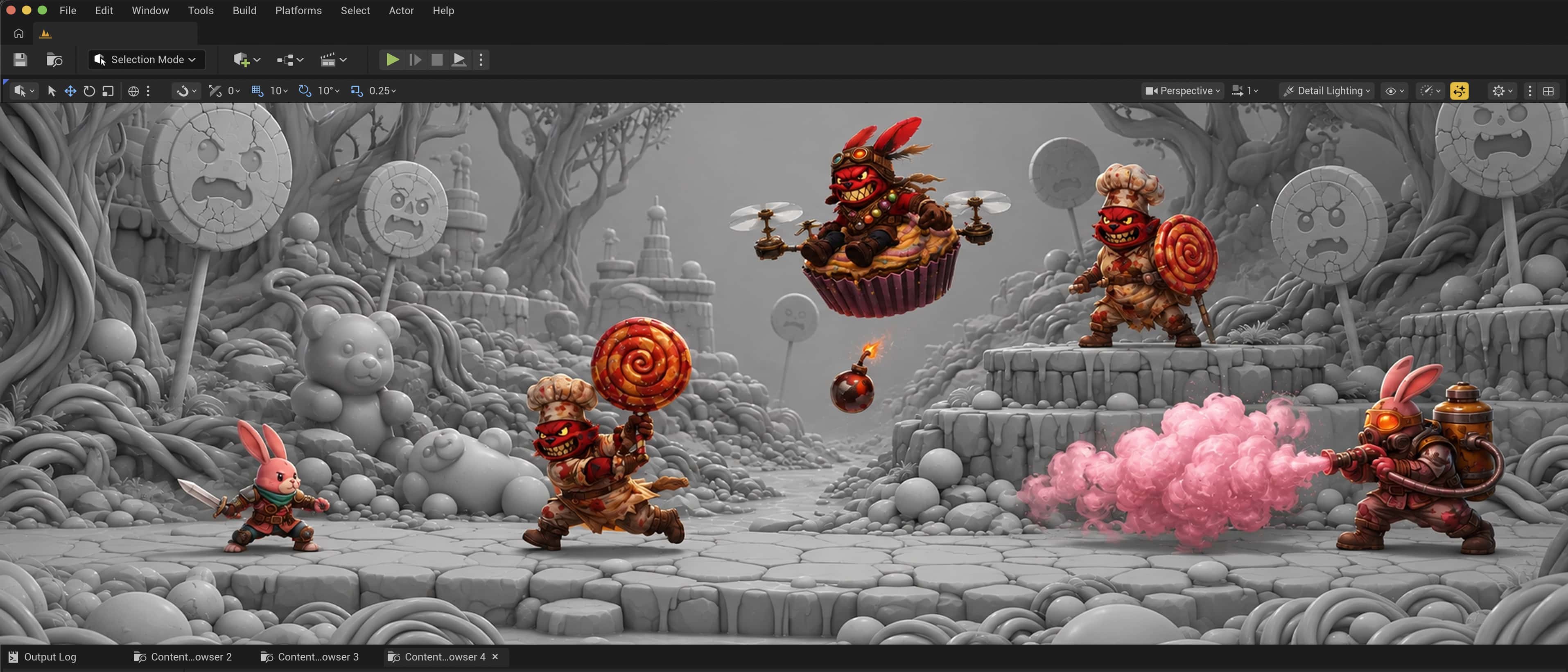
Unreal editor: a fight in a candy world, enemies wielding a lollipop and a pink flamethrower, a lit bomb in the centre.
04World VI — sugarSame combat grammar, opposite setting. The most useful test of the set: a gingerbread world is saturated with pink and red, and that's exactly where a red enemy risks vanishing.
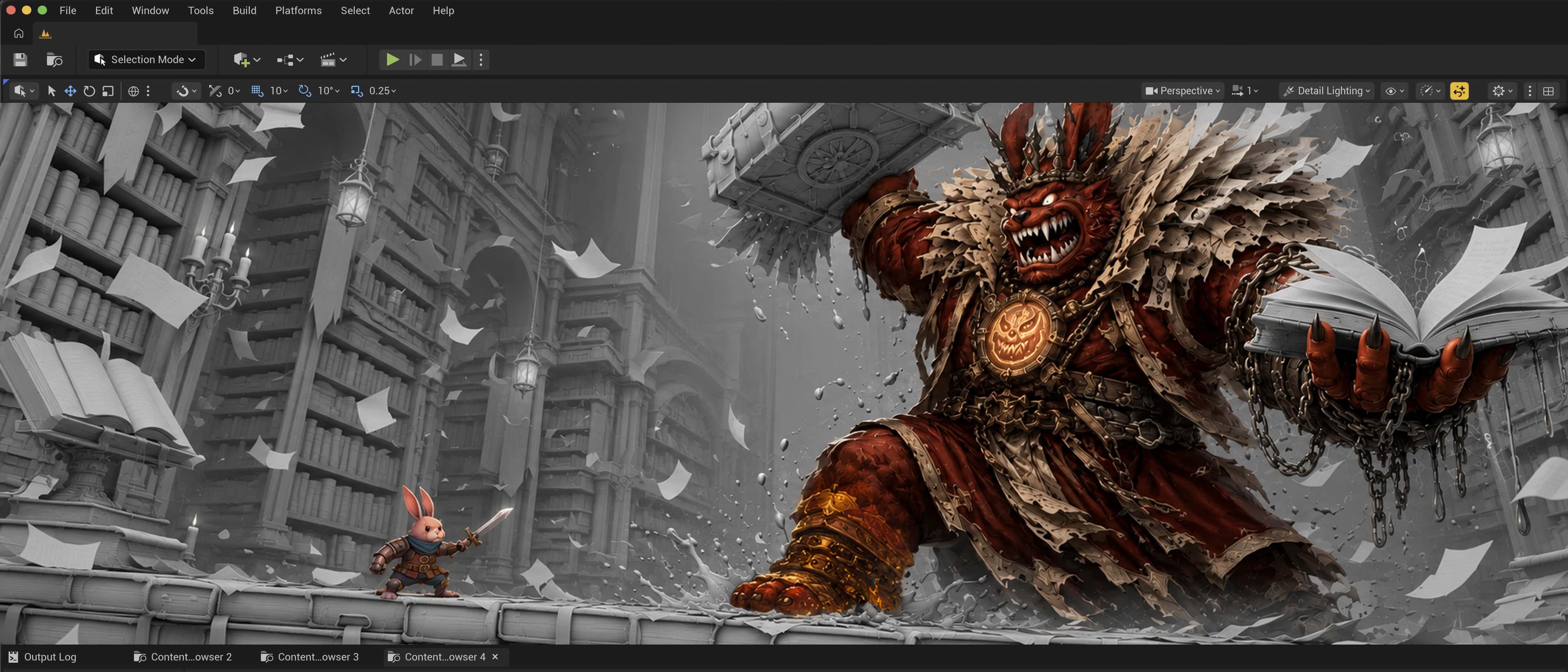
Unreal editor: the father on a walkway facing the library boss, hammer raised, pages suspended in the air.
05World VII — scale, laterThe same father, five worlds on. He hasn't shrunk: what he's facing has grown. Progression is visible before it's felt.
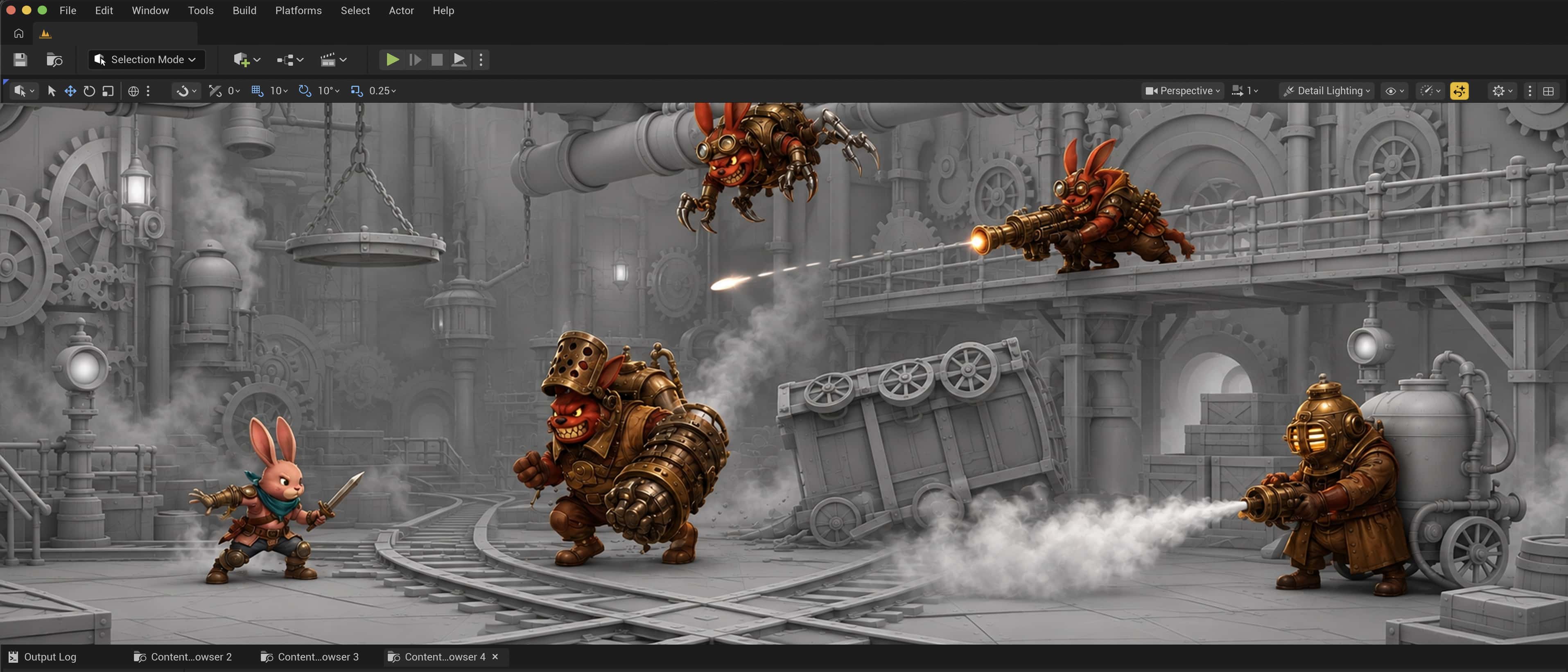
Unreal editor: a fight in a machine hall, steam-powered enemies on rails, a gunner on a gantry and a mechanical creature hanging overhead.
06World IX — the machineRails, steam, gunners overhead. Everything moves on a fixed interval here, which makes every jump measurable — and every mistake entirely yours.

Trailer

One minute.

The world, the tone, what we're building.

Opening frame of the trailer: the rabbit family on the porch of a lantern-lit house by the river under a full moon. The father sits with his daughter, who is holding her doll.

The map

Eleven places. No way back.

The path runs in order, but it never quite closes behind you. Every world keeps a door you can only open by returning, later, with something you didn't have yet.
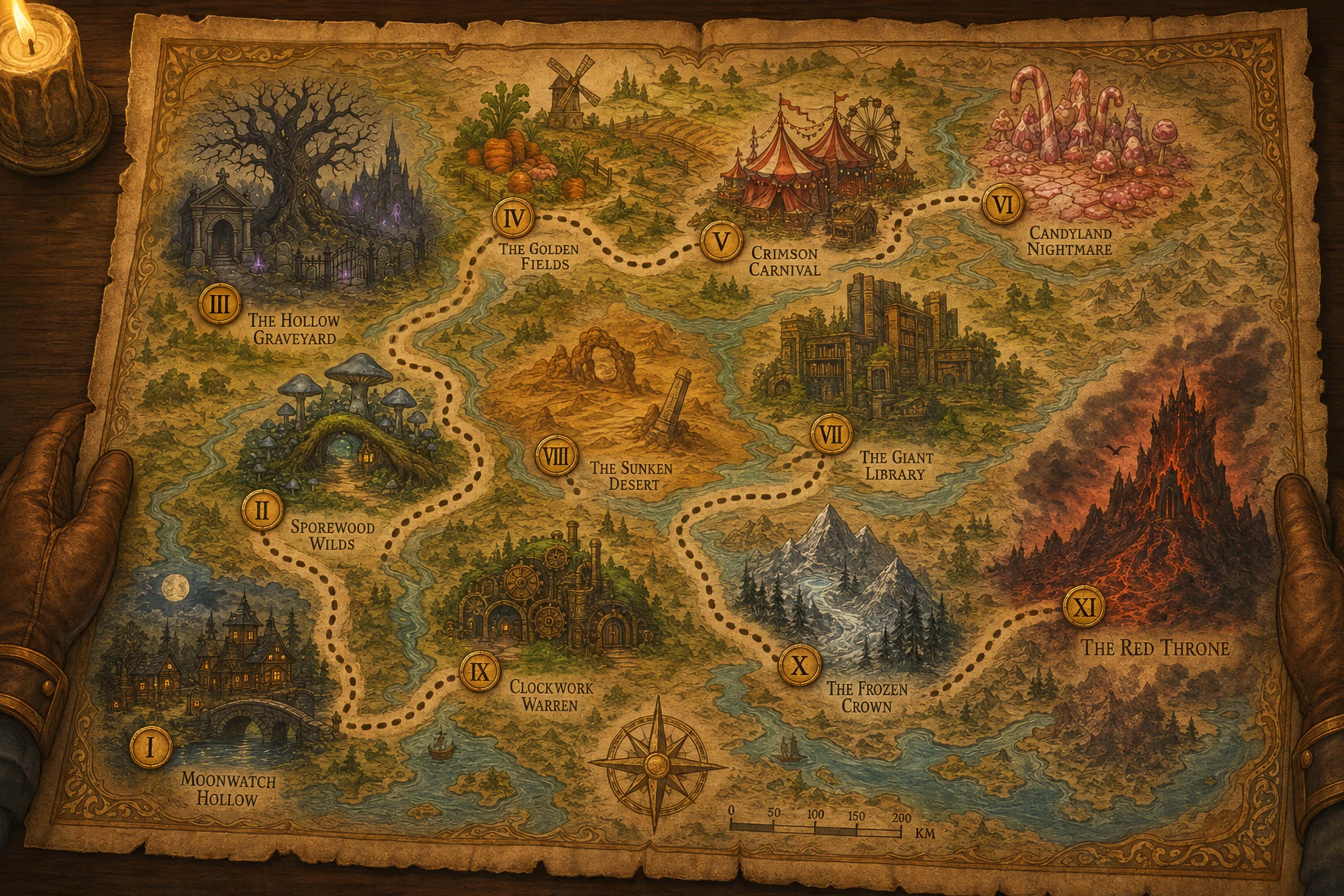
Parchment map of the eleven worlds of Cannibal Bunnies, held by two gloved hands in candlelight.

The player's map, as it appears in the game.

I · Prologue — no enemies

II

Sporewood Wilds

The forest that breathes

You leave the village by the bridge. The mushrooms light the path, which is lovely — until you work out that the light is bait. The first boss isn't the hardest; it's the one that teaches you that you can die.

III

The Hollow Graveyard

The tree that keeps the dead

A graveyard grown into the roots of a tree that is far too old. Here, what you bury doesn't stay buried, and the stone doors want something other than a sword.

IV

The Golden Fields

The calm that lies

Fields, a windmill, sunlight. The only world in the game that looks like it's doing fine. It's also where you learn what happened to the village — and why nobody came.

V

Crimson Carnival

The show goes on

The tents are up, the wheel turns, the music plays. There has been no one left to watch for a very long time, and it hasn't changed the programme at all.

VI

Candyland Nightmare

Everything is edible

The gingerbread, the roofs, the chocolate fountain. It all can be eaten, and that's the problem: in this world, appetite runs both ways.

VII

The Giant Library

Scale, inverted

Shelves as tall as towers, books you have to climb. This is where you earn the ability that reopens a door you left shut four worlds ago.

VIII

The Sunken Desert

What the sand swallowed

An arch, a fallen column, and beneath them an entire city. The desert isn't an obstacle: it's a lid.

IX

Clockwork Warren

The mechanical burrow

Gears for tunnels, steam for air. Everything moves on a fixed interval, which makes every jump measurable — and every mistake entirely yours.

X

The Frozen Crown

The last climb

The summit, the wind, and nothing left to pick up. This world gives you nothing new; it only checks that you learned.

XI

The Red Throne

He still carries the doll

A hall of lava, chains, a throne. The king is eight times your size and he has kept something very small hanging from his belt. You will recognise it.
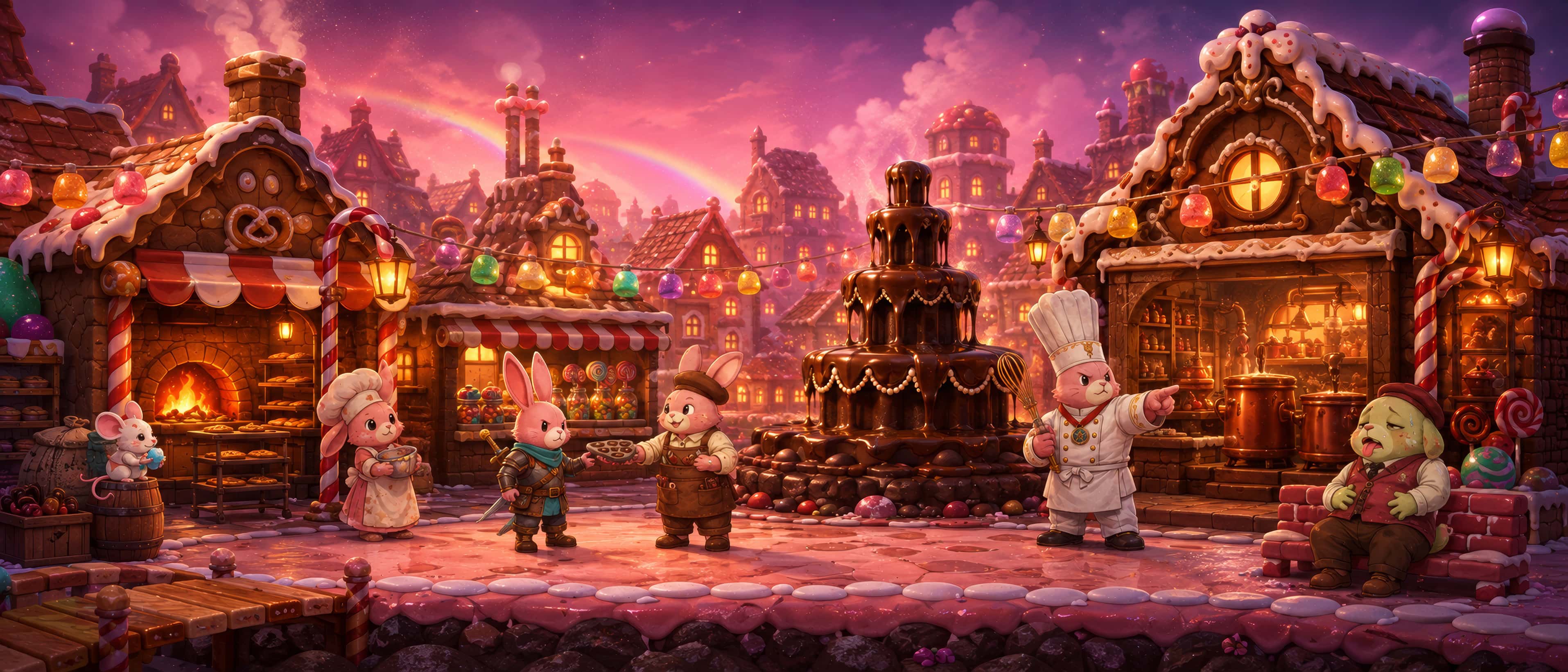
A gingerbread village under a pink sky, chocolate fountain at the centre, strings of glowing candy lights. The father talks to a merchant.

World VI

Everything is edible.Including you.

The archive

Thirty-nine levels, on paper, before a single line of code.

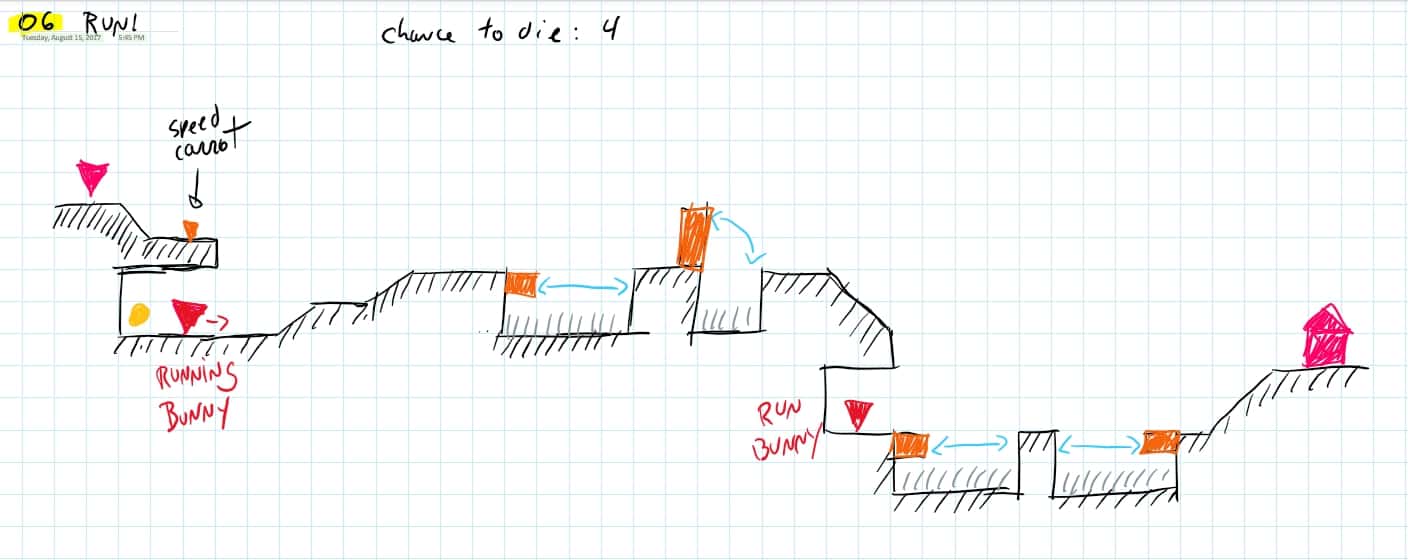
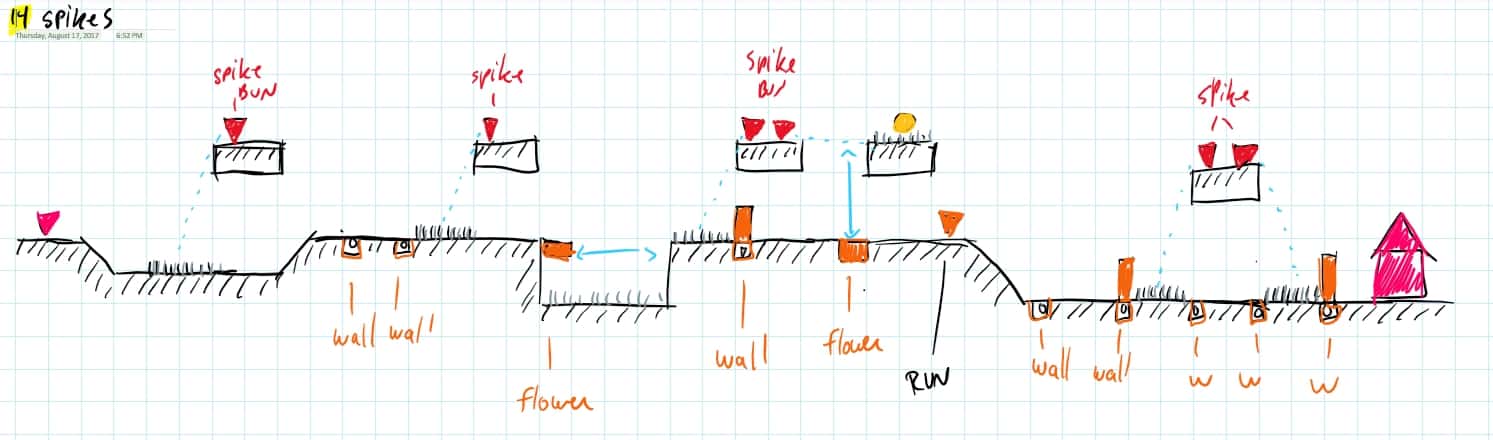
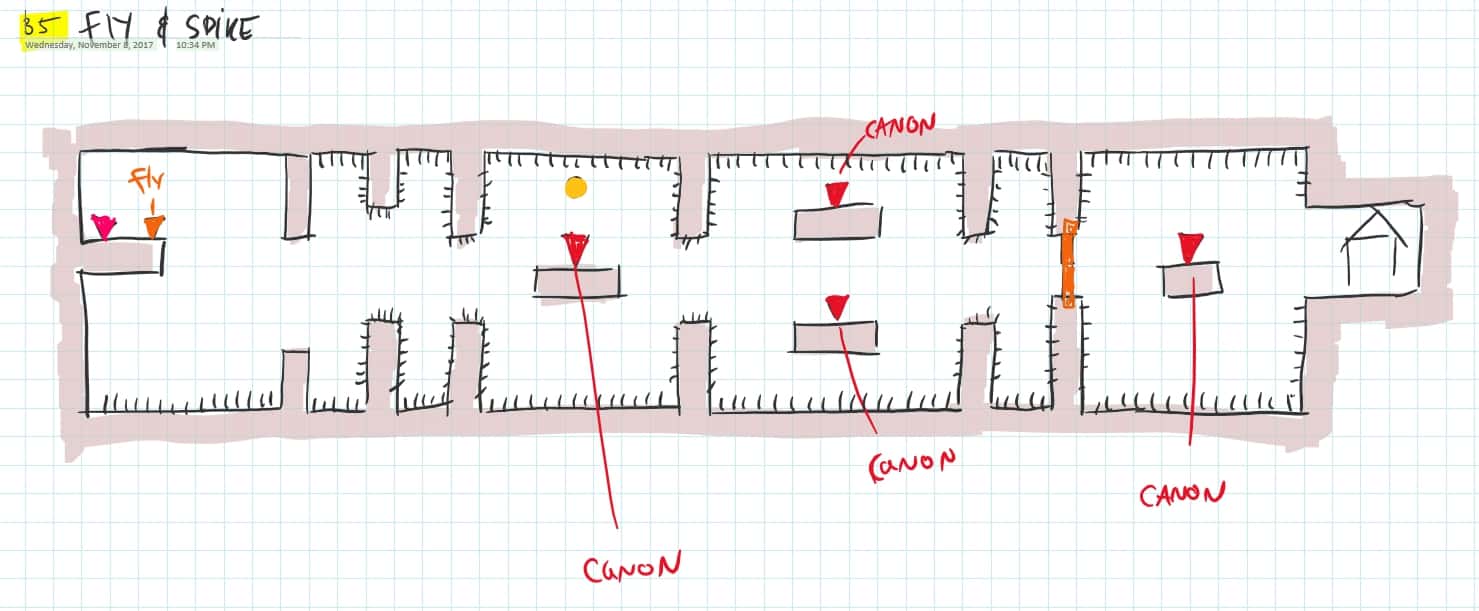
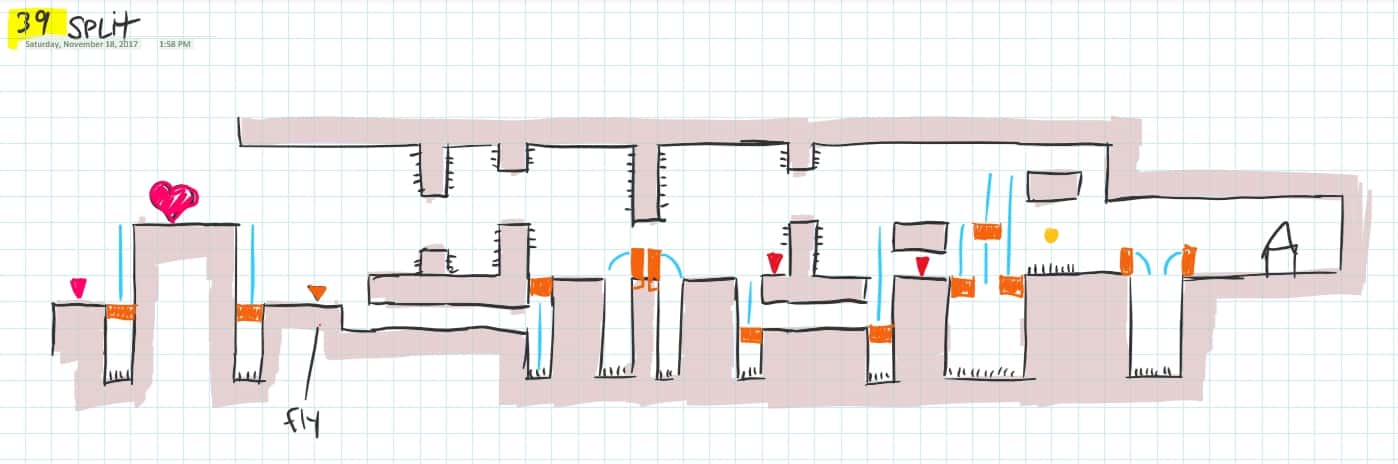
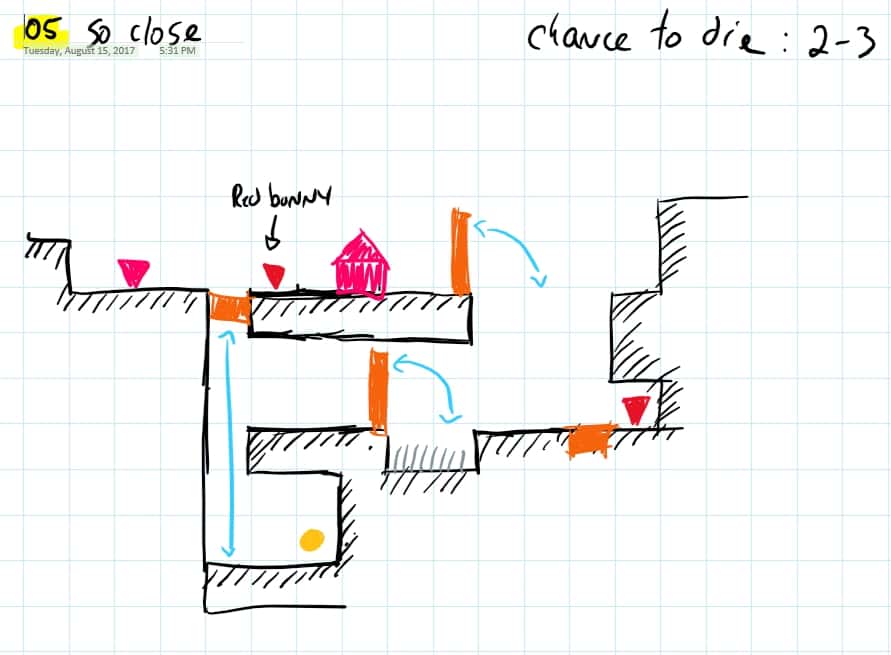
It starts in 2010 with character sheets, and it never really stopped. Every level exists first as an annotated plan: where the player runs, where they die, how many times. “Chance to die: 4” isn't a notebook joke — it's a difficulty target, and it gets verified in the engine afterwards.

The first game

The sheets the rabbit came out of. They're sixteen years old and the muzzle hasn't moved.
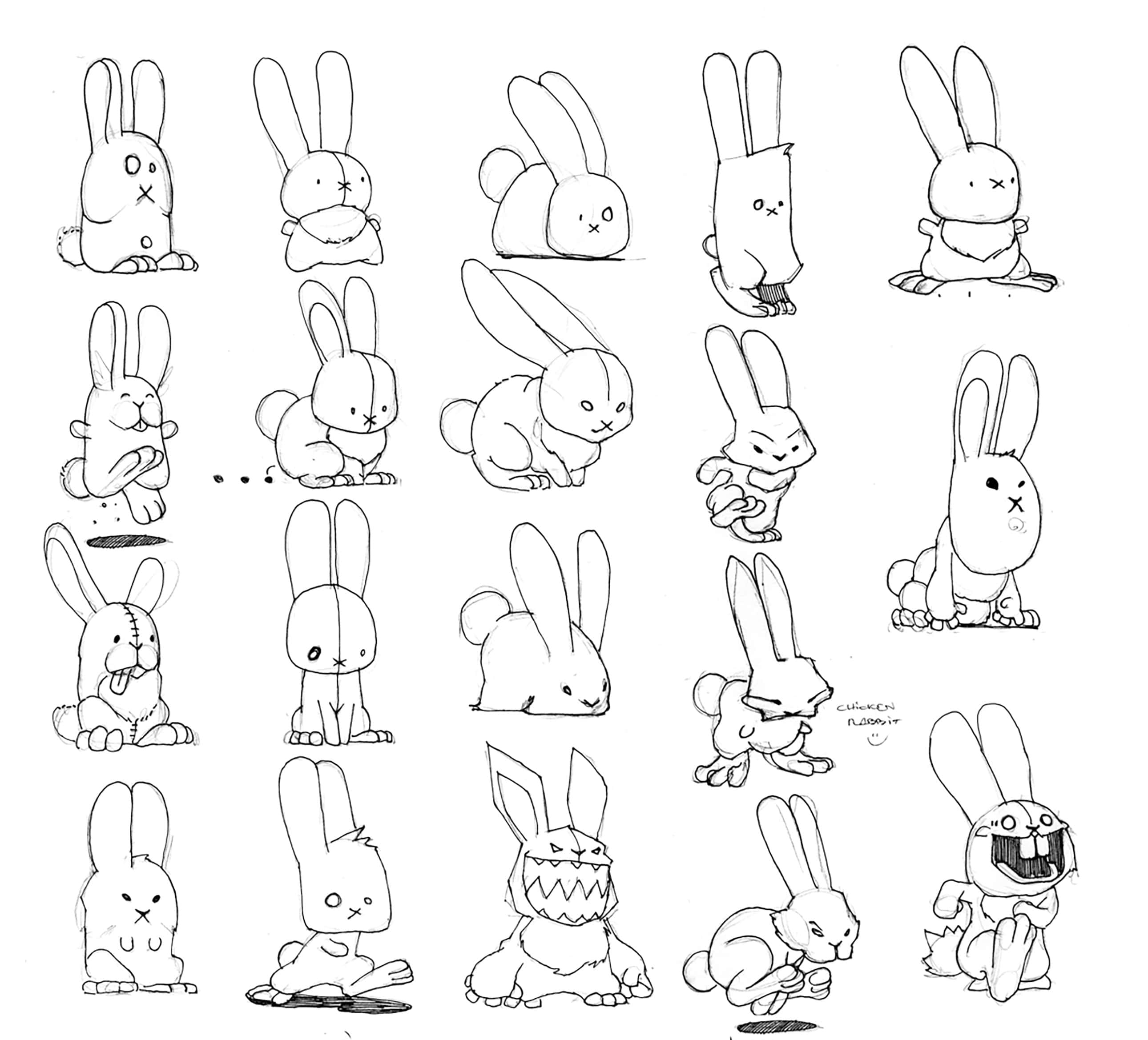
Character sheet: twenty rabbit poses and variations in pencil, one annotated “chicken rabbit”.
Character exploration
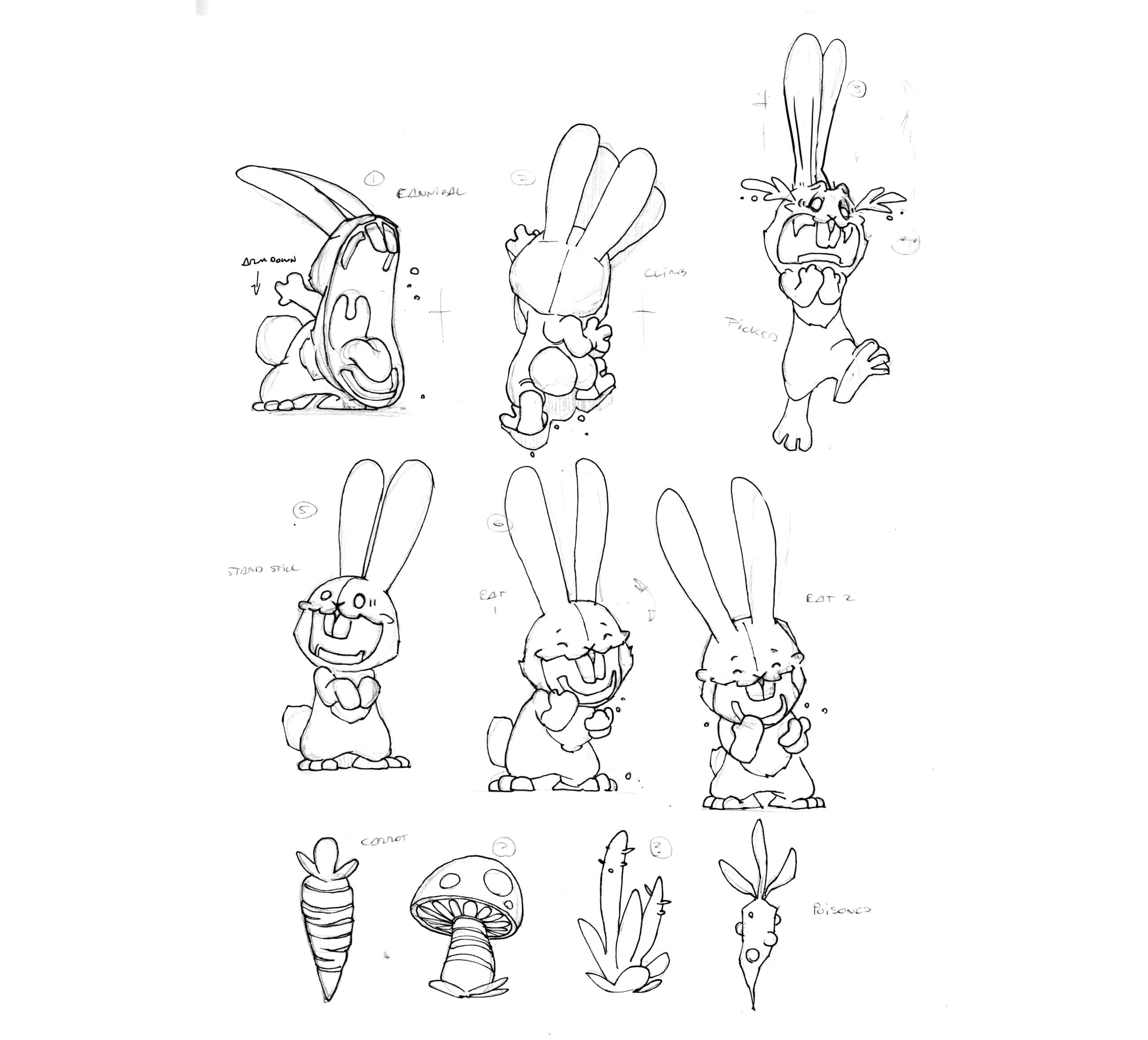
Annotated animation keyframe sheet: cannibal, climb, picked, stand still, eat 1, eat 2, and pickup items — carrot, mushroom, grass, poisoned root.
Animation keyframes, annotated pose by pose
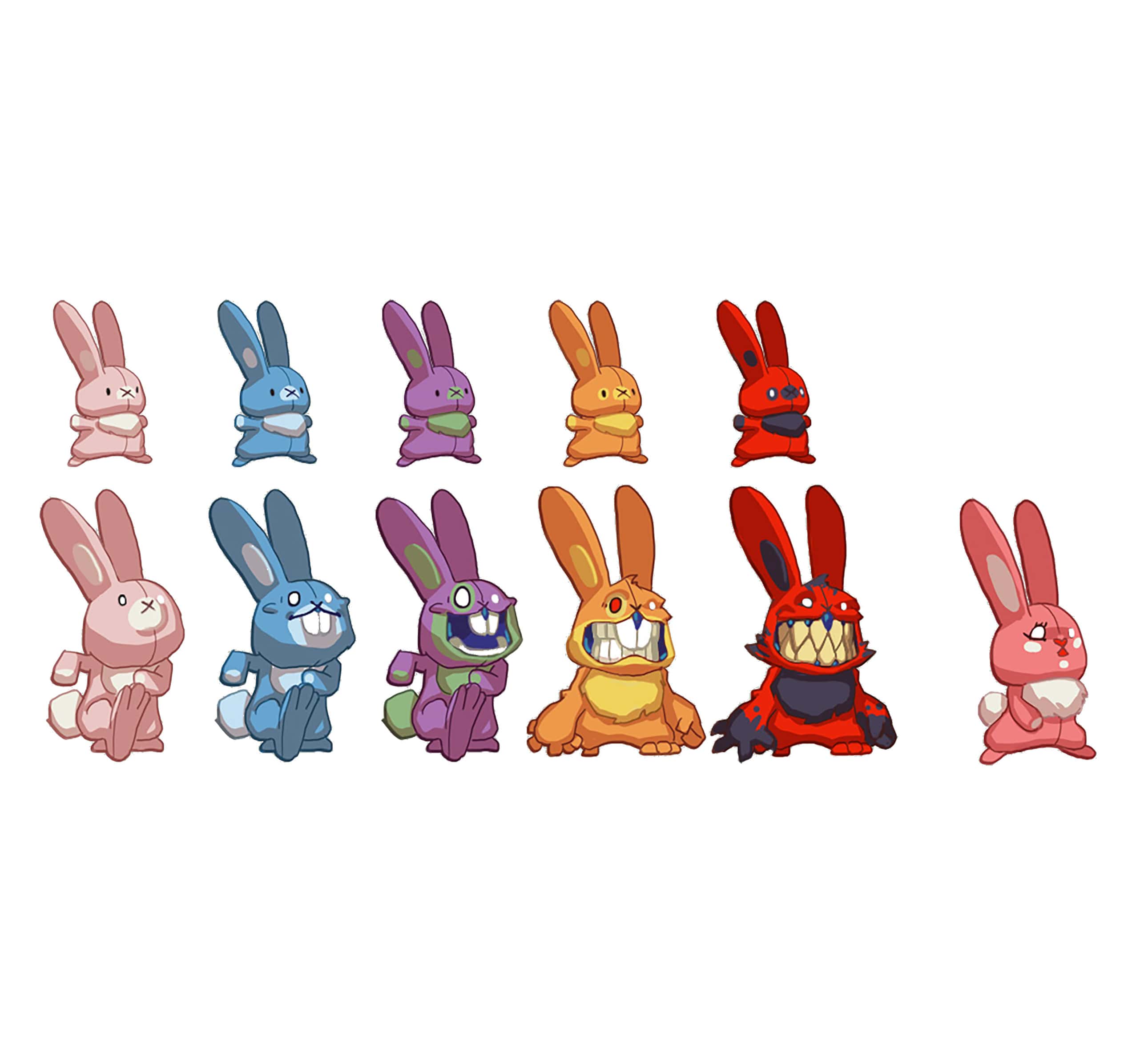
Colour sheet: eleven rabbits in two rows, from harmless pink to red and fanged.
The progression — from harmless pink to red and fanged

The level plans

Thirty-nine levels designed one at a time, each with its route, its traps, and its difficulty target written in the top right.
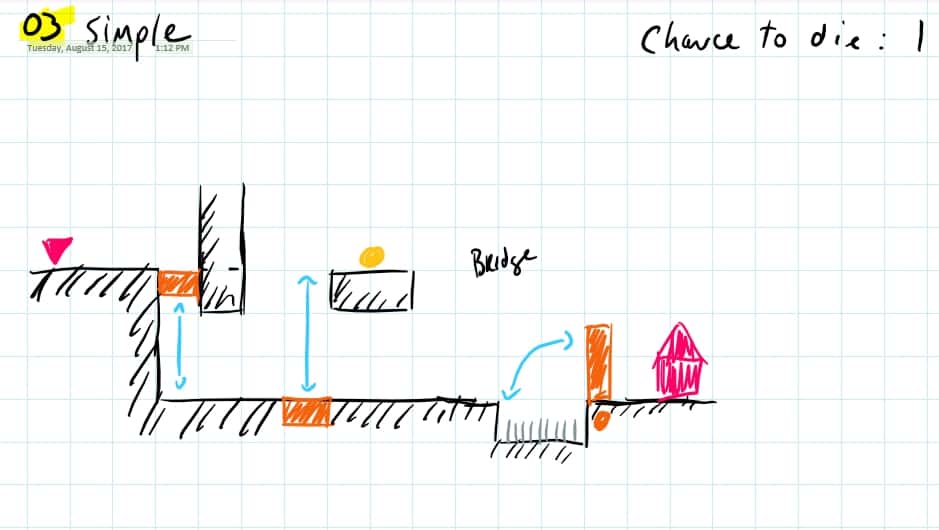
Annotated level plan “03 simple”, difficulty target 1.
03 — “Simple” · chance to die: 1
Annotated level plan “05 so close”, difficulty target 2 to 3.
05 — “So Close” · chance to die: 2–3
Annotated level plan “06 Run!”: horizontal route, speed carrot, running bunnies.
06 — “Run!” · chance to die: 4
Annotated level plan “14 spikes”: spikes, walls and flowers along the route.
14 — “Spikes”
Annotated level plan “35 Fly & Spike”: sectional room, cannons marked one by one.
35 — “Fly & Spike”
Annotated level plan “39 split”: the route divides into two branches.
39 — “Split”

Art direction

What it's becoming.

The same rabbit, sixteen years later, and everything he'll run into on the way.

The hero, today

A silhouette has to be recognisable backlit, at a fifth of screen height, in motion. Everything else is detail.
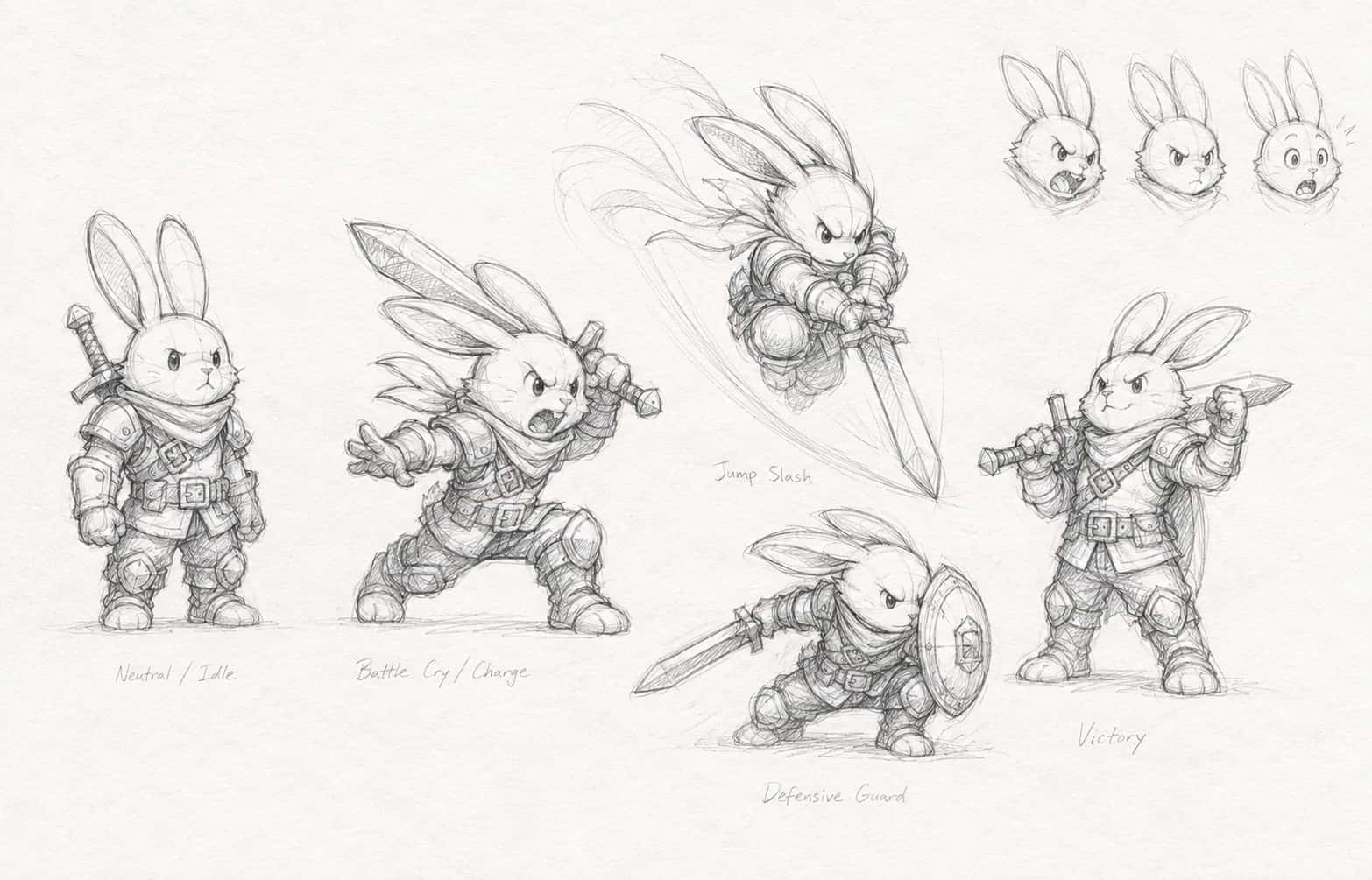
Hero pose sheet: neutral, battle cry, jump slash, defensive guard, victory, and three expressions.
Combat poses — neutral, charge, jump, guard, victory
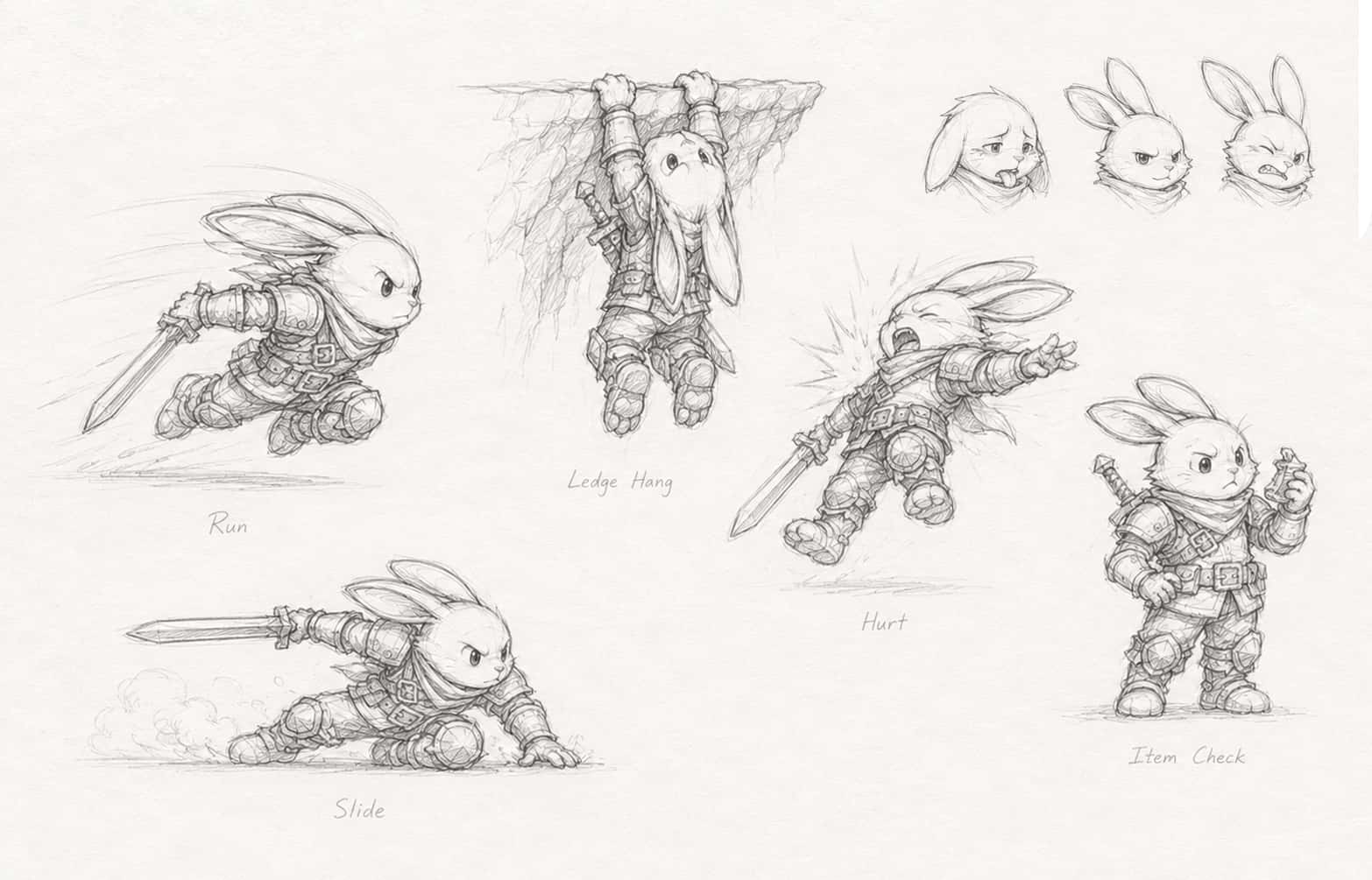
Hero movement sheet: run, ledge hang, slide, hurt reaction, item check, and three expressions.
Movement — run, ledge hang, slide, hurt, item check

Who you meet

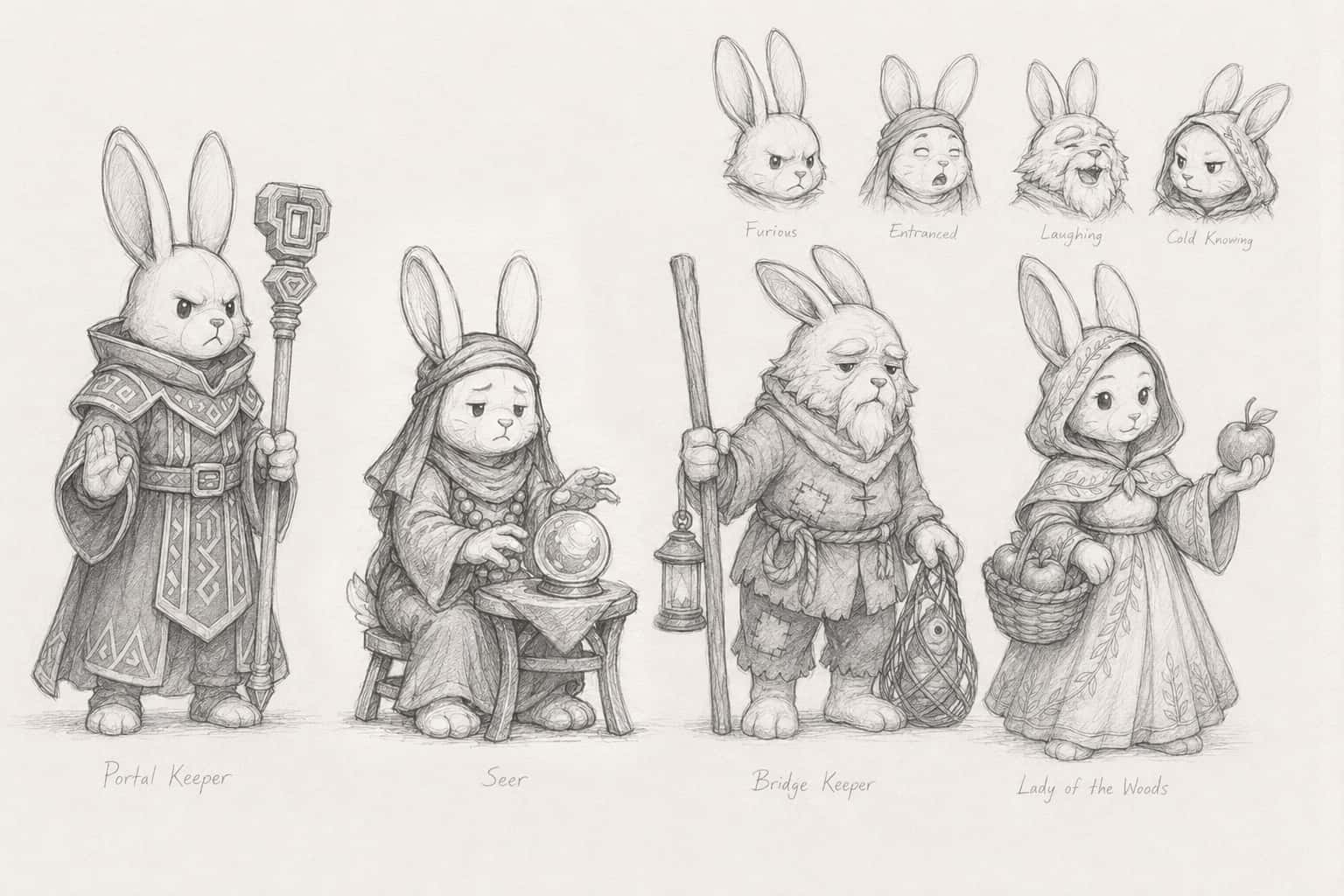
The blacksmith, the cook, the alchemist, the bridge keeper, the wandering musician. None of them is an extra: each holds an object, a rumour or a passage you'll need three worlds later.
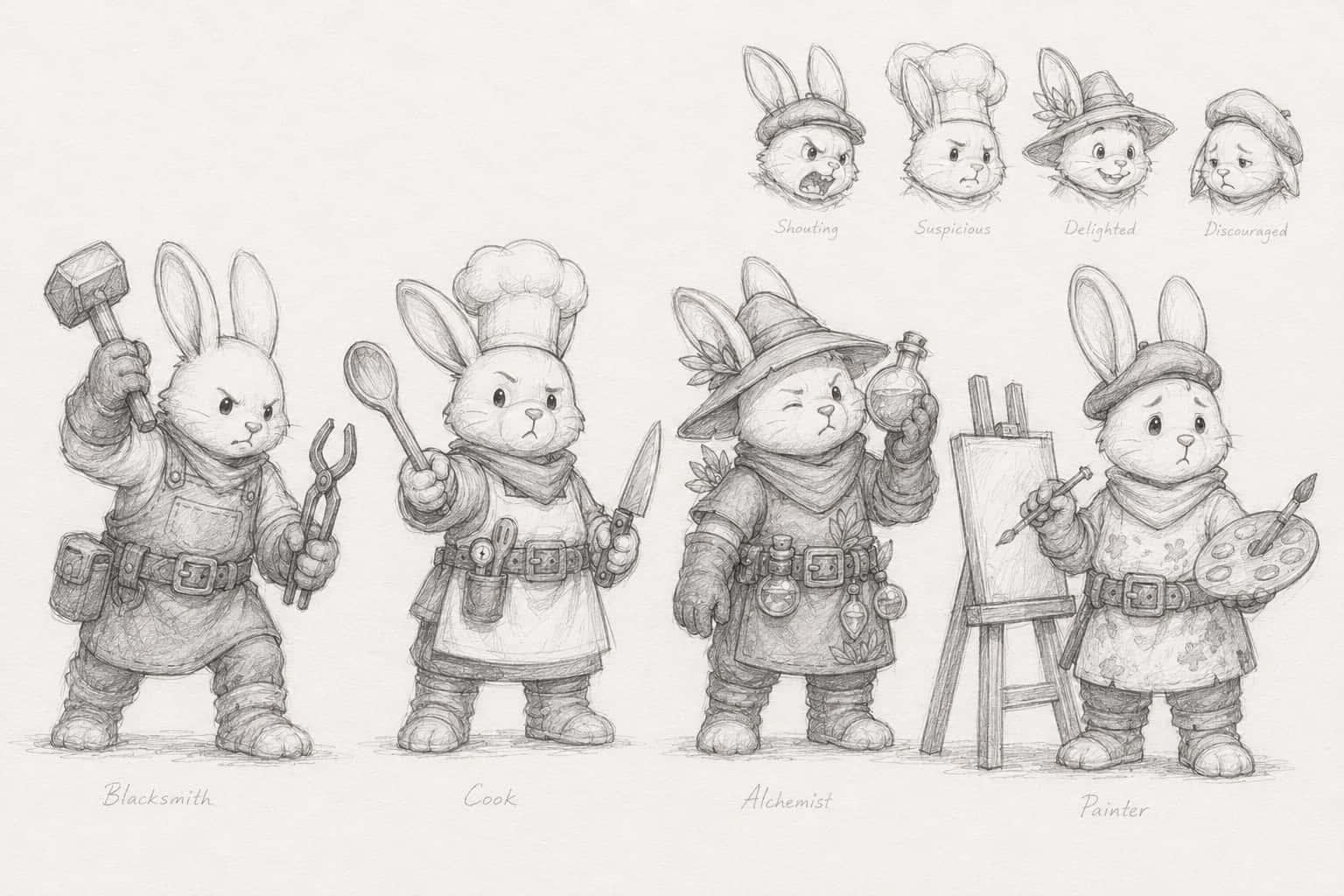
Four rabbit tradespeople in a lineup — blacksmith with hammer, cook with ladle, alchemist with vial, painter at an easel — with four expression studies.
The trades — blacksmith, cook, alchemist, painter
Four mysterious figures — portal keeper, seer with a crystal ball, bridge keeper with a lantern, lady of the woods with a basket.
The keepers — portal, seer, bridge, lady of the woods
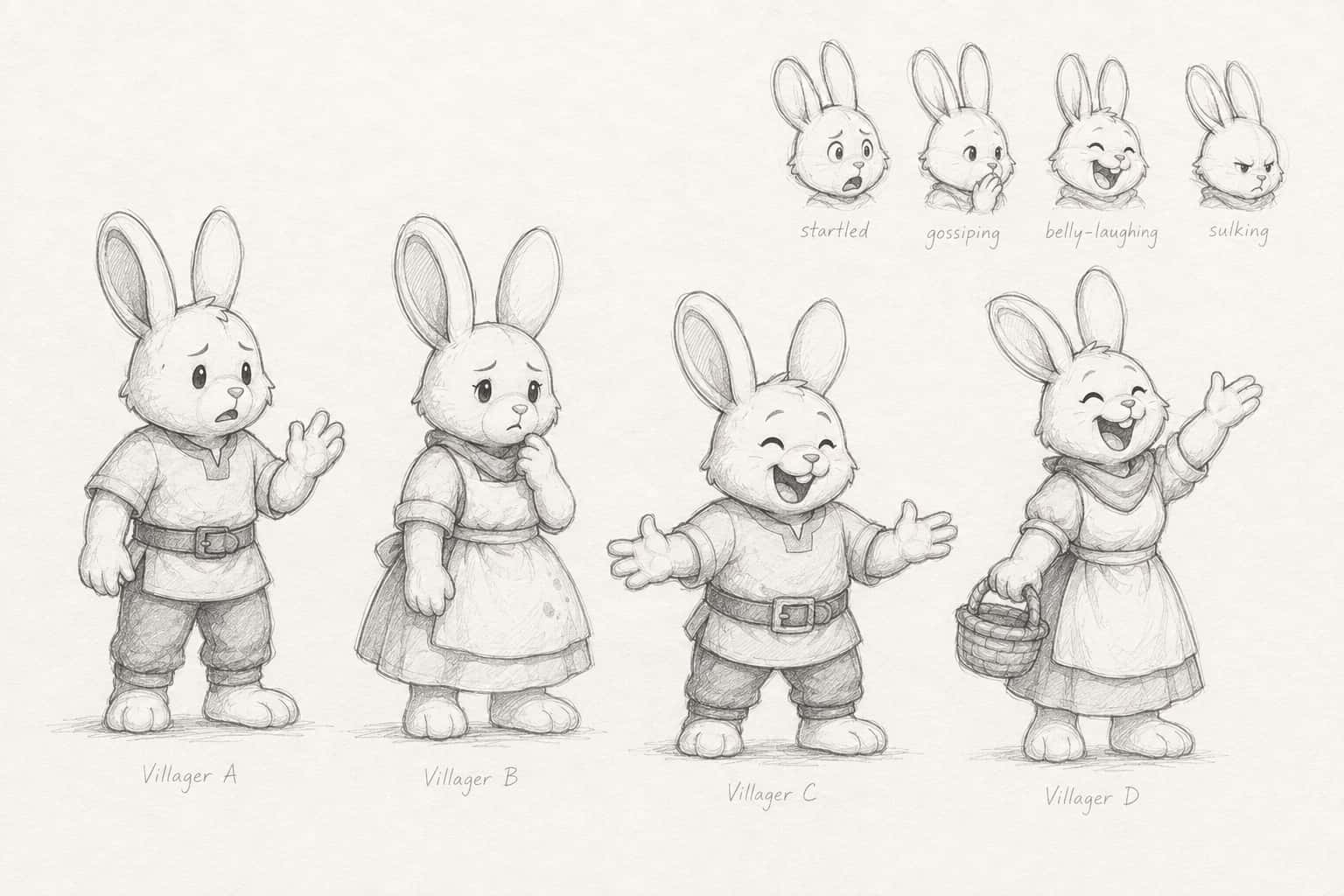
Four rabbit villagers in everyday poses, with four expression studies above.
The villagers — the ones who stay behind
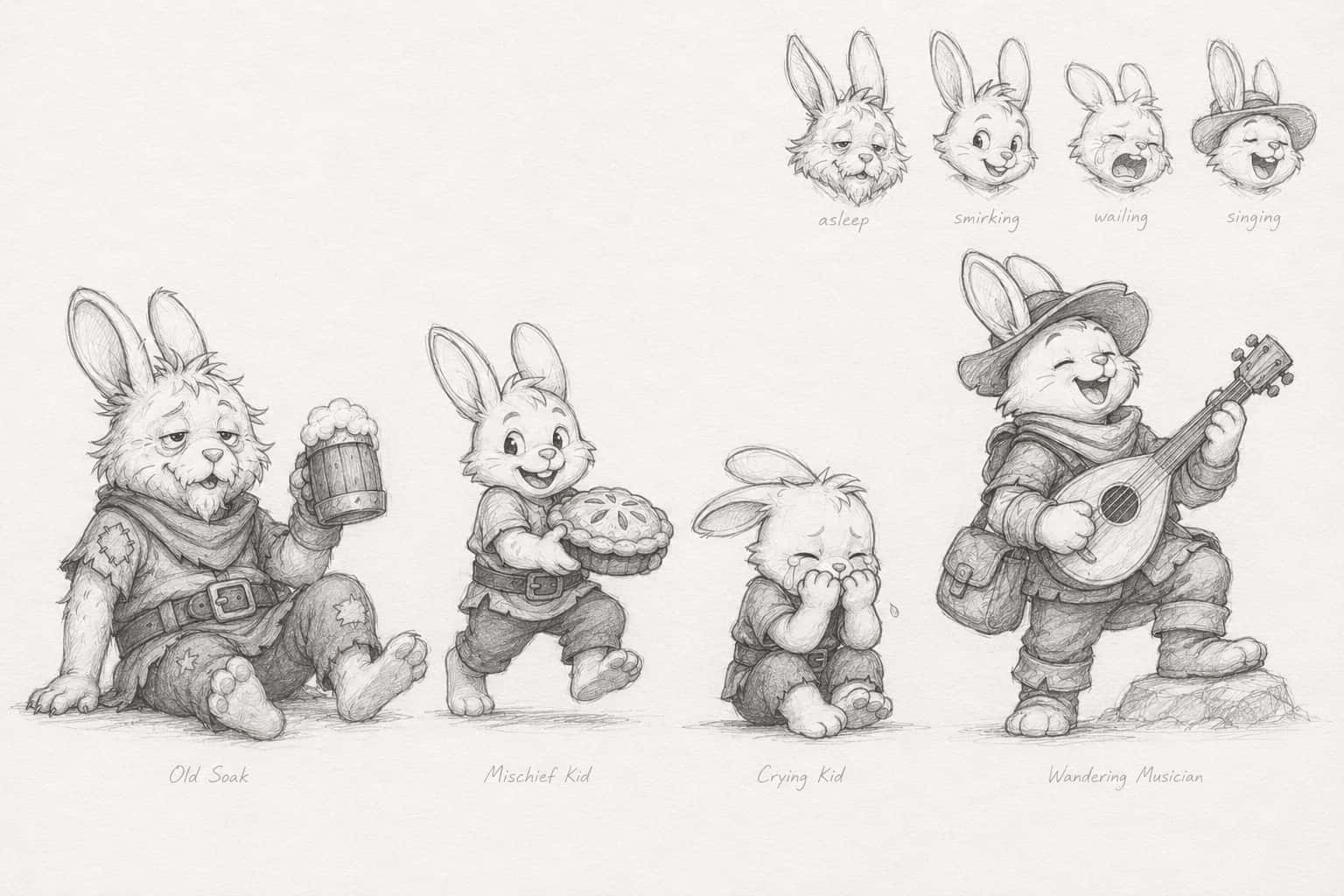
Four secondary characters — an old rabbit with a tankard, a masked child carrying a pie, a crying child, a wandering musician with a lute.
The rest — the old one, the children, the wandering musician

Who you fight

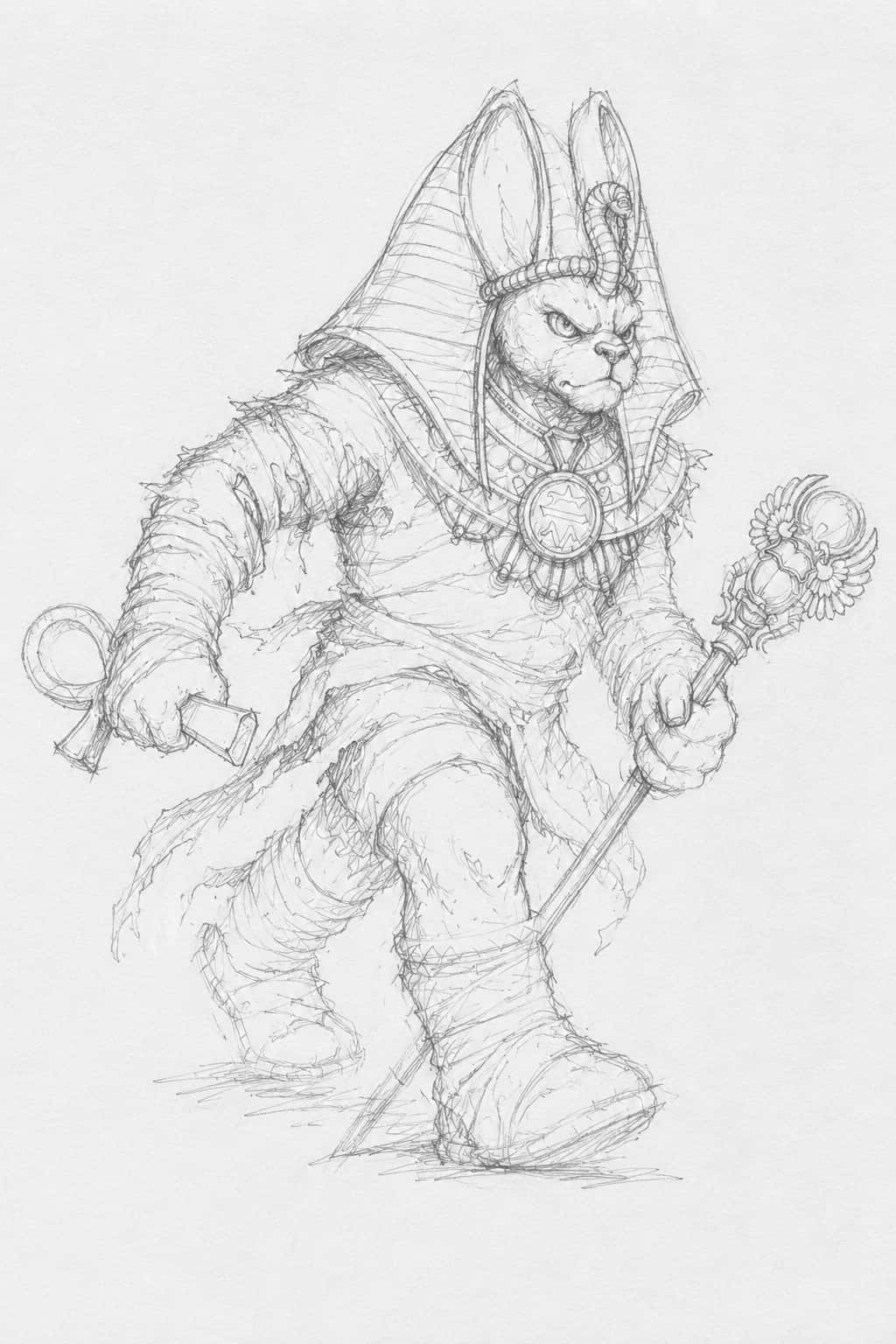
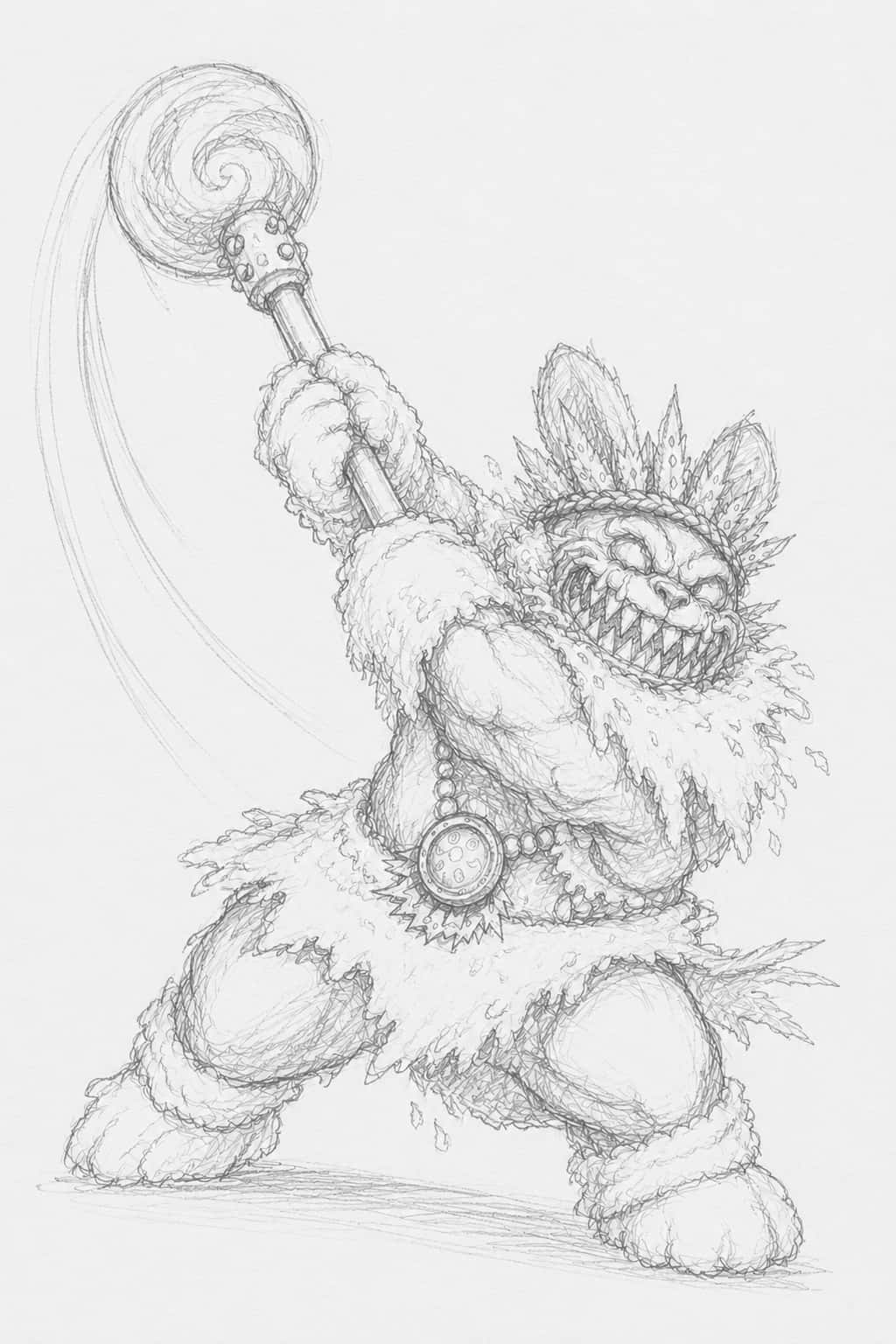
Every boss carries its world on its back: the miner drags his cart, the desert one his sceptre, the frozen one his mace. And the scale keeps climbing — the father is a fifth of the first, a twelfth of the last. Difficulty is visible before it's felt.
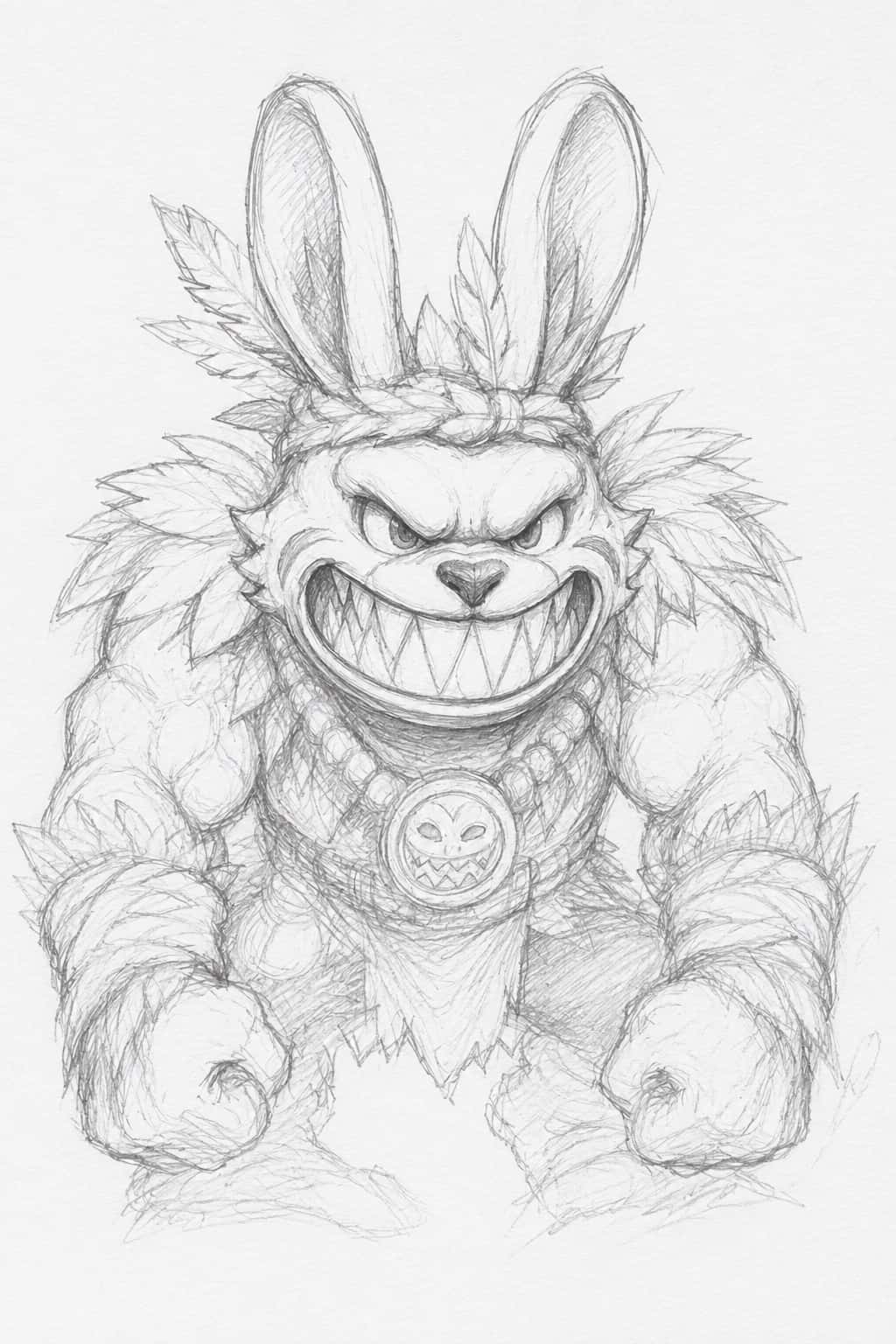
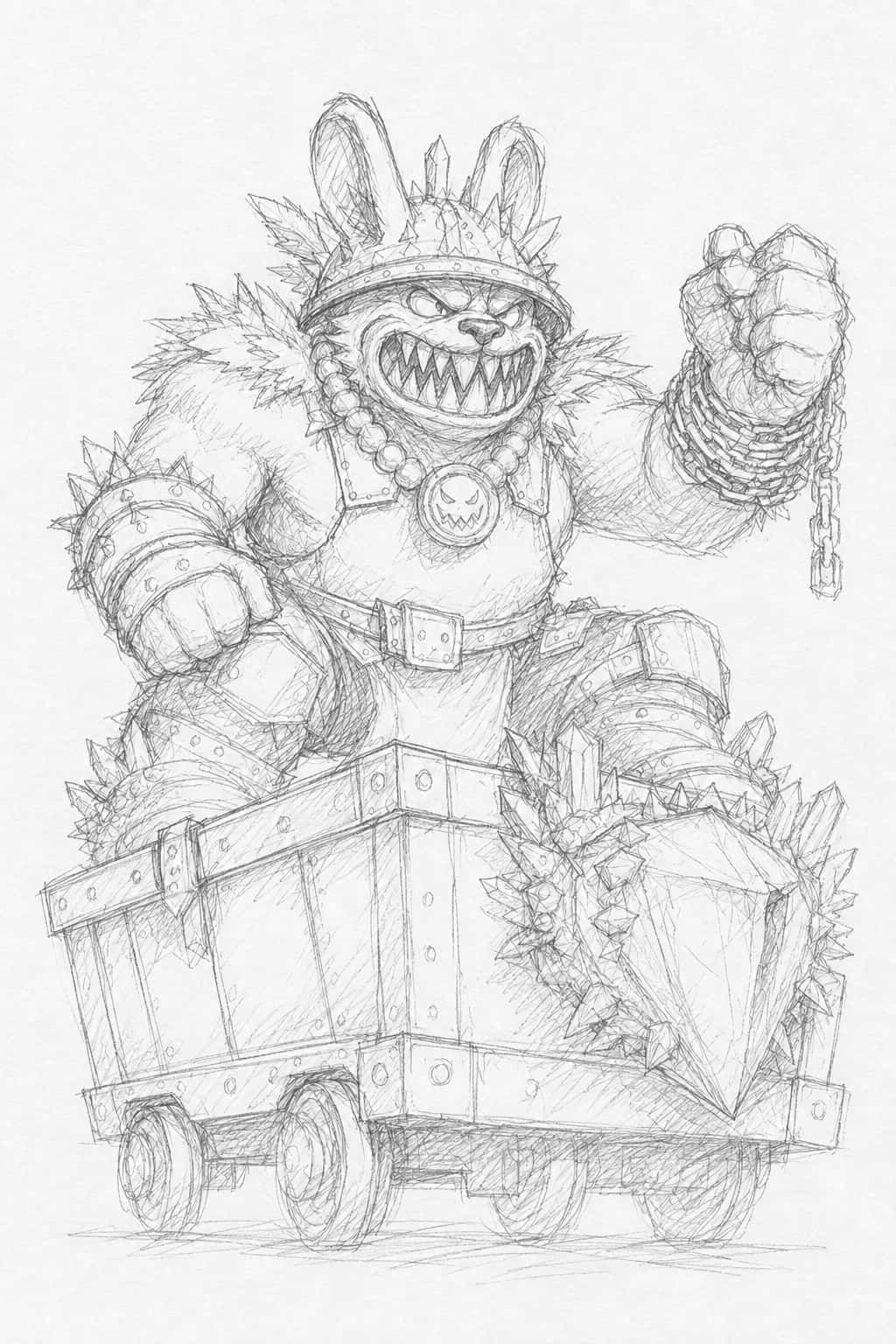
Boss study: massive rabbit facing forward, toothed jaw, collars, skull medallion, oversized fists.
The base study — the jaw has to read from a distance
Armoured boss pushing a mine cart loaded with crystals, chain in his fist.
The miner — his cart is part of his arsenal
Bandaged boss in a pharaoh headdress, ankh in one hand, sceptre in the other.
The withered — world VIII, beneath the sand
Frost-covered boss mid-swing, the mace head shattering ice into shards.
The frozen — world X, the last climb

Gear

He leaves with a stone sword.

Every world has its own gear, made of what you find there: graveyard iron, clockwork brass, throne ember. You don't unlock a list of items — you leave each world wearing what you just walked through. And every piece changes the silhouette as much as the way you play.

  • 01Starting leatherWhat he took off the wall on his way out. A chipped stone blade, one bracer, and nothing covering his back.
  • 02Graveyard ironWorld III. Stone gives way to steel and the back is finally covered. You take hits — and you run slower.
  • 03Clockwork brassWorld IX. The gauntlet strikes once, heavily — but it opens doors no blade opens.
  • 04Summit frostWorld X. Cut from the ice at the summit. It doesn't rust — it melts, and you have to get back down first.
  • 05Throne emberWorld XI. Taken off the king himself, helm included. By this point it isn't armour — it's what's left of the one who wore it.

Identity

What he eats shows in the end.

Eleven worlds of carrots, mushrooms and things he shouldn't have picked up. The body remembers: you don't cross Candyland the way you cross the desert, and it shows in the silhouette long before it shows in the stats.

  • 01SickThe poisoned root in world II. You can eat it. You shouldn't.
  • 02LeanEleven worlds picking up only what he strictly needed. Fast, fragile.
  • 03NormalThe reference build. Neither fast nor heavy — the midpoint.
  • 04HeavyHe let nothing go by. Slow, takes everything, and the armour pulls at the straps.
  • 05MuscledThe right mushroom, at the right time, for eleven worlds. It costs you elsewhere.

Face

Him, you choose before you leave.

Eyes, ears, muzzle, markings. The face is set on the first screen, before the first carrot, and it doesn't move again all game. One other thing never changes either: the scowl he starts with.

  • 01NormalThe reference face. Round head, almond eyes, upright ears.
  • 02AngularElongated head, slanted eyes, long thin ears. A cream blaze runs up the muzzle.
  • 03WideFlattened head, large wide-set eyes, short broad ears, tufted cheeks.
  • 04TousledLong fur, a tuft between the ears, freckles on the muzzle. The outline has no clean edge left.
  • 05BucktoothTwo incisors over the lip, the jaw pushed forward, heavy whisker pads.
  • 06Odd-eyedOne blue eye, one brown, and a cream patch that splits the face in two.
  • 07StripedDarker bands across the cheeks and forehead, tufts at the ear tips.
  • 08CurlyThe coat curled into small rings, wavy ears, kinked whiskers.
  • 09BandedA cream band across the muzzle, and the eyes sitting in a darker field.
  • 10NarrowedTwo slits under heavy brows. Nothing impresses him, and it shows.

Wear

He doesn't reach world XI the way he left.

The armour gives way piece by piece, the scarf disappears, the marks stay. Nothing repairs itself between worlds — and by the end, the state of the character tells the journey better than any progress bar.

  • 01IntactWorld I. The gear just came off the wall. He hasn't seen anything yet.
  • 02TornWorld III. The leather has opened at the side, the scarf has lost half its length.
  • 03BrokenWorld VI. A strap gave out and was re-tied by hand. The left bracer is gone.
  • 04GuttedWorld IX. The pauldron is gone, the chestpiece gapes open. The scarf is down to a band.
  • 05In ruinsWorld XI. Half the armour is gone, the blade is snapped. He's still standing.

The bar

What we keep on screen while we work.

We are not trying to remake these games. We are trying to deserve being named next to them.

  • Ori and the Will of the WispsFor movement precision and the refusal of decorative scenery.
  • Rayman LegendsFor legibility — you read a screen in a tenth of a second.
  • The Secret of Monkey IslandFor the idea that an object in a pocket can be worth a key.
  • CupheadFor bosses you learn by heart and eventually dance with.
  • Hollow KnightFor a map that folds back on itself instead of spreading out.

Target release

2027

Targeted platforms. Console versions depend on publishing agreements currently in progress.

  • Steam
    Steam
  • PlayStation 5
    PlayStation 5
  • Xbox Series X|S
    Xbox Series X|S
  • Nintendo Switch 2
    Nintendo Switch 2

Interface and voice in French and English.
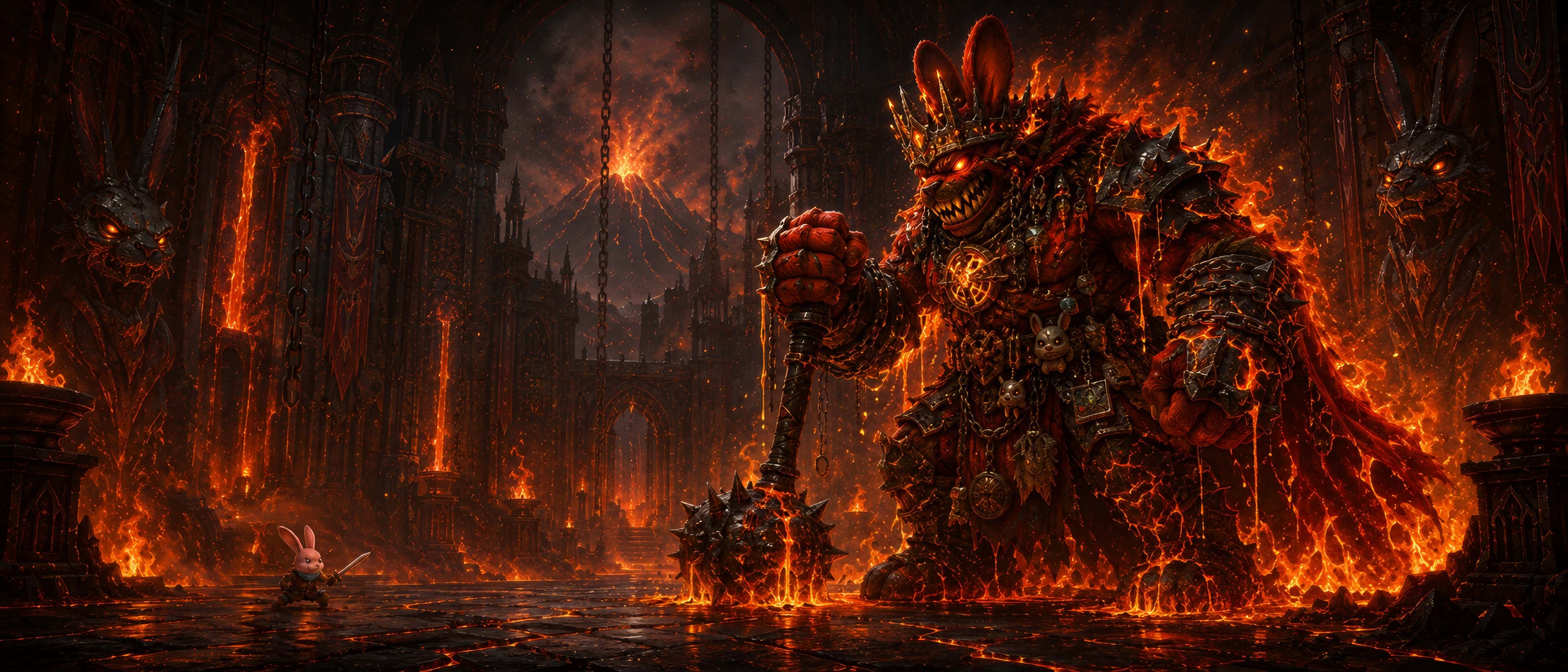
A lava throne room. A colossal crowned rabbit king in chains towers over the tiny father at the bottom of the frame, sword in hand.

World XI

Eight times your size.And he kept the doll.

What's next

What's missing is time.

The worlds are designed, the engine runs, the levels are on paper. What remains to fund is the year and a half of production between a demo and a finished game.

Free

Add it to your wishlist

This is the single most useful thing you can do, and it costs nothing. Wishlist counts are what publishers and public funds look at before committing. Three seconds from you is worth more than a long speech from us.

Soon

Follow the campaign

A crowdfunding campaign will open once the vertical slice and the trailer are ready. Leave your email and you'll hear the day it starts — not before, and not for anything else.

Partners

Invest or co-publish

The studio is established in Québec and the project is eligible for multimedia title production programmes. Deck, budget and playable build are presented on request.

He left to find her in 2010. It would be nice if he found her.